

Ideas > The Body of Work
The Body of Work
Jedidiah Alex Koh frameworks
The frameworks, books, research and practice of Jedidiah Alex Koh, MCC
One inquiry into what happens in a conversation, in three lines, disclosed in layers.
How the conversation changed
Over twenty years, one line of inquiry: what happens in a conversation that changes what a person can see, and what a leader, a coach, or anyone at all can learn to do about it.
I have followed that question through more rooms than I expected to. Executive coaching rooms across Singapore, Malaysia, Taiwan, Japan and other parts of Asia, and then, through the coaching communities I teach and belong to, across the world: boardrooms and ministries, family businesses and start-ups, a military academy, a hospital, the guest hall of a monastery. Rooms where a leader was deciding whether to stay. Rooms where a whole team had stopped telling the truth to each other and knew it. One-to-one rooms, where the work was not leadership at all but a person's own transformation: the marriage, the vocation, the story they had been telling about themselves for forty years. And rooms with no walls, because some of the deepest changes I have witnessed happened on a walk, by a river, in a bamboo grove, on a mountain path, where nature did what no question of mine could do and the person came back down changed.
I have also sat on the other side of the table: as a coach educator running ICF-accredited programmes at Levels 1, 2 and 3, and the advanced programmes for mentor coaches and supervisors; as a mentor coach, supervisor and assessor, listening to several hundred of other people's coaching conversations with a standard in one hand and a person in the other; and as an author, which is where an idea finds out whether it can stand without me in the room to hold it up. For a long time now I have also been a student of the older Asian ways of seeing that our leadership vocabulary keeps forgetting it inherited.
The room decides what can be said, and the conversation decides how big the room is.
The work on this site is what came out of all those seats. It is organized into three lines, one for each kind of reader, and disclosed in layers: the definitions and diagrams here are public and may be quoted with attribution. The teaching lives in the books and in the rooms. If you are new here, start with the map, then follow one line. If you want to know where the ideas come from before you trust any of them, the eighth movement is for you.
The Map
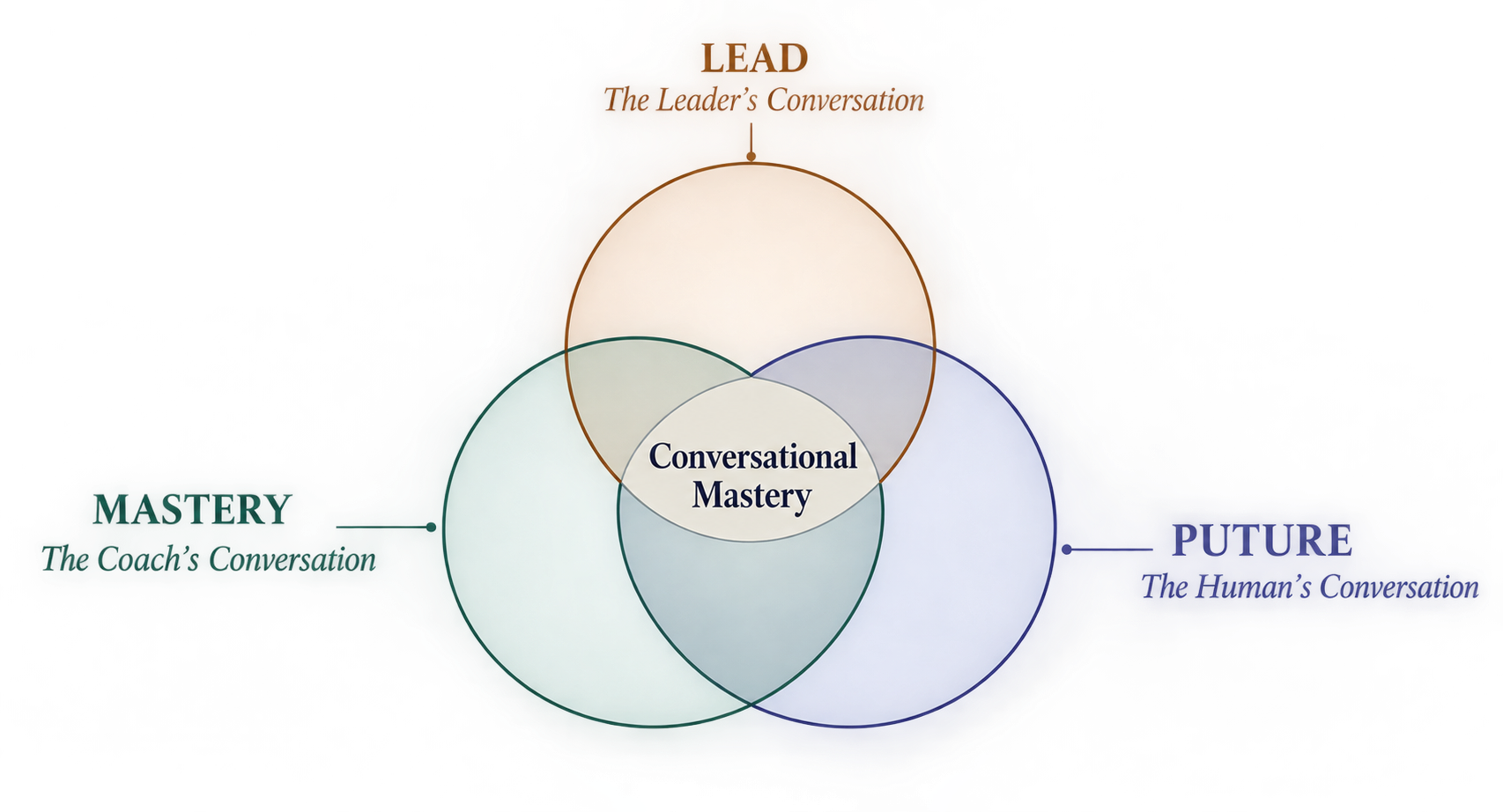
The quality of leadership is often revealed in the quality of its conversations.
The leader's conversation
The LEAD Coaching Model. Front door: LEAD Where You Stand.
The coach's conversation
Mastery in Coaching. Front door: Coaching Is Conversational Mastery.
The human's conversation
PUTURE and Metaphorium. Front door: Brave Your Story.
Frameworks Books Research Practice Reflections
The map reads from the top. One sentence sits above everything: the quality of leadership is often revealed in the quality of its conversations. Beneath it are three lines, each written for a different reader. The leader's conversation is carried by the LEAD Coaching Model and the five LEAD books. The coach's conversation is carried by Mastery in Coaching, with Coaching Is Conversational Mastery, Resonance and Confluence as its books and the research shelf beneath it. The human's conversation is carried by PUTURE and Metaphorium, with Brave Your Story: The Twelve Thresholds as its front door. Along the bottom are the shelves the whole site is built on: frameworks, books, research, the practice library and the reflections.

What an idea is for
Most of what a room calls impossible is only unexamined. I have sat in enough leadership teams to know the sound of it: a possibility raised, a silence, and then the sentence that closes the door, "that is not how it works here." Nobody in the room is wrong about the facts. They are wrong about the size of the room. Leadership, in the version of it I have spent my working life on, is the practice of seeing what the room has decided cannot be seen, and then saying it in a way that lets other people see it too.
That is what an idea is for. Not to be admired, and not to be owned, but to be passed through. An idea is a doorway: you stand in one room, you go through it, and the room on the other side is larger than the one you were in. The four ideas on this page are doorways of that kind. LEAD is a doorway into a conversation that has a shape. Mastery in Coaching is a doorway into what a coach becomes after the certificate. PUTURE is a doorway out of the single future we keep projecting and into the field of what could be. Metaphorium is a doorway into a world small enough to enter and learn from. None of them is the room. The room is the person you are talking to.
The way through a doorway is a conversation, and not every conversation will do. The ones that matter are generative in a plain sense of the word: something arrives in them that neither person brought. In the books I call that arrival an insight, and I have spent a long time on the difference between a conversation that exchanges information and one that evokes something new. As LEAD with Clarity
puts it,

Before we develop any skill, before we master any framework, before we learn what to do
in a conversation, we must first learn to feel what conversations do.
LEAD with Clarity, chapter 1
An idea you cannot walk through is only decoration.
There is a bridge in Tokyo I keep coming back to, and I write about it among the places below. Its lesson is the one I most want a leader to leave this page with: whatever you are facing, there is never only one way across. The impossible is very often a single bridge, closed, mistaken for the river.
So the ideas on this site are not a system. They are a set of doorways, each tested in rooms before it was written down, each with its boundary stated, and each still open. They will change, and the changes will be dated. What will not change is the question they serve: what happens in a conversation that changes what a person can see, and what any of us can learn to do about it.
Ten principles of ideas
I am asked, often enough to have thought about it, what I believe about ideas themselves: not my ideas, but ideas, the things that arrive in a conversation and change what a person can see. These ten are what I have come to. Some are mine; several are older than me and I have only found my own words for them; all of them have been tested in rooms.
An idea is a doorway, not a destination.
The test of an idea is not whether people admire it but whether they walk through it into somewhere larger, and keep walking.
Every idea begins as a noticing.
Before it is a thought, an idea is something one person saw that the room did not, and had the nerve to say.
Ideas arrive in conversation before they arrive in solitude.
The insights that change a life are rarely thought up alone. They arrive between people, in a conversation that made room for them.
An idea is only as large as the room that receives it.
Most of what a room calls impossible is only unexamined, and the size of the room is decided by the quality of its conversations.
The future is a line; possibility is a field.
We keep projecting one future from what we know, and the field of what could be is standing all around us while we do it.
What cannot be reached head on can be entered sideways.
When a question is too large to think about, build a smaller world, a metaphor, a story, a room with three chairs, and walk in.
There is always another bridge.
Whatever you are facing has more than one way across, and the ways you have already built are more numerous than you remember.
An idea without a boundary is a mood.
A model that claims to work everywhere is not a model. The boundary is the part that makes it usable by someone who is not you.
Ideas are tested in rooms, not in applause.
An idea has to survive real people under real pressure before it survives the page. Until then it is a hunch, and it stays in the notebook.
The name is the last thing an idea earns.
Naming too early makes a half-idea feel finished and a borrowed idea feel original. An idea earns its capital letter with a definition, a boundary, a worked example and a date.
The Three Lines of Mastery
LINE 1
The leader's conversation
For managers and senior leaders who coach through conversation, and for the people who develop them. The LEAD Coaching Model is the architecture: five phases carried by four letters, recursive rather than sequential, taught in five volumes and three curricula. If you lead people and have never been trained as a coach, begin with LEAD Where You Stand. If you want the full architecture, LEAD with Clarity is the reference.
The LEAD Coaching Model →
LEAD Where You Stand →
LINE 2
The coach's conversation
For coaches from ACC to MCC, mentor coaches, supervisors and coach educators. Mastery in Coaching is the pillar: what mastery looks like after the credential, what develops it, and what an assessor actually sees at the transcript level. Coaching Is Conversational Mastery is the front door; Resonance (mentor coaching) and Confluence (supervision) are the set texts; the research shelf sits beneath
all three.
Mastery in Coaching →
Coaching Is Conversational Mastery →
LINE 3
The human's conversation
For anyone who wants a better ordinary life through better conversation, with themselves as much as with others. PUTURE is a word I coined for the field of possibilities that opens when we stop projecting a single future. Metaphorium is the discipline of building small worlds in order to think. Brave Your Story: The Twelve Thresholds is where this line begins.
PUTURE →
Metaphorium →
Brave Your Story →
The frameworks and models
LEAD™
The LEAD Coaching Model is a five-phase architecture for coaching conversations: Lead Outcomes, Examine, Explore and Evoke, Aligned Insights, and Decide and Act — five phases carried by four letters, since the second E holds two movements.
Read the page →Mastery in Coaching™
Mastery in Coaching is the body of work on what develops in a coach after the credential — the practice, mentoring, supervision and evidence that let a coach see more with the tools they already have.
Read the page →PUTURE™
PUTURE is a coined word for the field of possibilities that opens when a person stops projecting a single future and starts sensing what could be — not the future, a line, but the field.
Read the page →Metaphorium™
Metaphorium is design exploration of the interior — building a small world you can enter, out of whatever material is at hand, to learn what the mind cannot reach head on.
Read the page →The L.I.A.M. Framework™
Line 1The L.I.A.M. Framework™ is a team leadership coaching model that helps leaders improve a team's communication, alignment and collective progress, in four stages: Listen to Understand, Inquire for Awareness, Align from Intention, and Move to Progress.
Most teams fail not at capability but at understanding — people work hard on slightly different pictures of the same goal, unsaid. L.I.A.M. is the shape I use when the unit of work is a team: it slows the group down so what's unsaid gets said and what's assumed gets tested, agreed by everyone rather than the loudest voice. Where LEAD structures a conversation between two people, L.I.A.M. gives a leader four moves for the conversation a team has with itself.
| Stage | What it asks of the leader |
|---|---|
| L · Listen to Understand | Listen to the team's context: what is said, what is unsaid, what is felt and what is intended. |
| I · Inquire for Awareness | Use reflective questions to uncover assumptions, misunderstandings and misalignment, without judging and without immediately fixing. |
| A · Align from Intention | Connect individual expectations and responsibilities with the team's shared intention and outcome. |
| M · Move to Progress | Translate that alignment into focused action and forward movement. |
Eclectic Excogitate Coaching
Line 1Eclectic Excogitate Coaching is the methodology for leadership coaching inside organizations: eclectic because no single school serves every leader, and excogitate because the work is thinking a thing through, not applying a technique to it.
Built for the Asian leadership context, where ignoring culture and hierarchy won't survive a first session. Four wings hold it together — adaptive, integrated, reflective, and resilient — and six elements carry it through an engagement, aligned throughout to the ICF Core Competencies and Code of Ethics.
| The six elements | What happens |
|---|---|
| Individual performance needs assessment | the leader's needs, challenges, goals, context, learning style and cultural background are established before anything is designed |
| Goal setting and action planning | goals are co-created with the leader and the organization, with milestones that can be tracked |
| Tailored individualized coaching | methods, techniques and frameworks are selected and blended for this leader rather than delivered from a standard curriculum |
| Whole of person approach | the leader is coached as a person, not as a role: culture, identity, resilience, confidence and life outside the work are all in the room |
| Agility and accountability | the design changes as the leader's situation changes, inside structures both parties agreed to |
| Ongoing evaluation and feedback | progress is measured and fed back through the engagement, not only at the end |
Resonance™
Line 2The Resonance Model is the architecture for mentor coaching: attending to three things at once — the Score, the Voice, the Room — through five movements.
Mentor coaching had a competency standard but almost no architecture. The governing image is a tuning fork that sets a second fork sounding without touching it — the coach finds a pitch rather than an instruction. Taught in Resonance and the advanced mentor coaching programme.
Resonance →Confluence™
Line 2The Confluence Model is the architecture for coaching supervision, built on currents and streams meeting: the generative current, the culture stream, differentiated confluence, and five movements — with a meta-map that locates every other model in the field.
Supervision is where a coach brings their work to be seen, not assessed. It calls itself research-informed, not yet research-validated, and its final chapter separates what rests on literature from what rests on practice.
confluence →Co-Creative Coaching Conversations™
Line 2Co-Creative Coaching Conversations is the stance beneath the whole line: a conversation made by two people, not delivered by one, so the outcome, exploration, insight and action are discovered together, not supplied.
It sounds obvious and is the hardest thing to hold — the discipline of not taking the expert seat, letting the person's own intelligence do the work while you hold the architecture. The through-line of the Level 2 and Level 3 programmes.
Programmes →The 3-Axis Lens™
Line 1The 3-Axis Lens widens a person's view of a situation along three axes, so a conversation can move in more than one direction without losing its shape.
A stuck conversation usually has one degree of freedom. The lens restores the rest: up and down between purpose and specifics, sideways between other paths, and back and forth between what the past taught and what the future could hold.
lead-coaching-modelConversational mastery™
Line 2Conversational mastery is not a skill set but a way of being — an orientation toward human encounter that begins with the willingness to examine one's own interior architecture.
Technique gets a coach to competence; what happens after is different work, described in Coaching Is Conversational Mastery, which names four conversational states and the pillars carrying the practice from individual to team to organization.
Coaching-is-conversational-masteryThe Craft Arc
Line 2The Craft Arc describes how a practitioner develops through four phases — Apprentice, Journeyman, Craftsman, Elder — with credentials as markers on the path, not the path itself.
Every craft that has lasted has an account of how a person moves through it. Published in LEAD Together, it sits under the Mastery in Coaching pillar, asking what develops after the credential is on the wall.
Mastery-in-coachingThe Nihombashi Principle
Line 3The Nihombashi Principle says there is never only one bridge — every person has more ways across a challenge than they remember, and the work is helping them see the next one.
Named for the Tokyo bridge from which all the roads of Edo Japan were measured — four centuries of crossings stacked on one spot. It carries no trademark; the bridge is not mine.
Nihombashi-principleThe way of water (mizu leadership)
Line 3The way of water is a philosophy of practice, not a technique: seven qualities — flow, adaptability, persistence, depth, clarity, nourishment, power — held as orientations for anyone trying to change what force has failed to move.
It came from a river in Kyushu and a boulder the river had gone through. Like Nihombashi, it carries no trademark — mizu is simply the Japanese word for water.
The-way-of-water →
Small ideas
create big changes.
What an idea is for
People
Almost every idea here began with someone I won't name — a regional head in Singapore, mid-sentence, realizing she'd been assessing a man against a job she hadn't yet described.
Stories
I think in stories before frameworks. A path through a bamboo grove in Kyoto taught me the difference between a formula and an architecture.
Experience
Some ideas came from my own failures in the chair. The split between harvest and carry — LEAD's one real addition — came from watching clients' insights fade by Thursday.
Nature
Some of the deepest changes I've witnessed happened outdoors, where the landscape did the evoking. Mizu came from watching a river, not a book.
Research
I'm a practitioner, not an academic, but I credit what came before — GROW, the ICF competencies, the metaphor scholars, the possibility literature.
The Page
Five books, one boundary each. Writing is where an idea finds out whether it can stand without me in the room to hold it up.
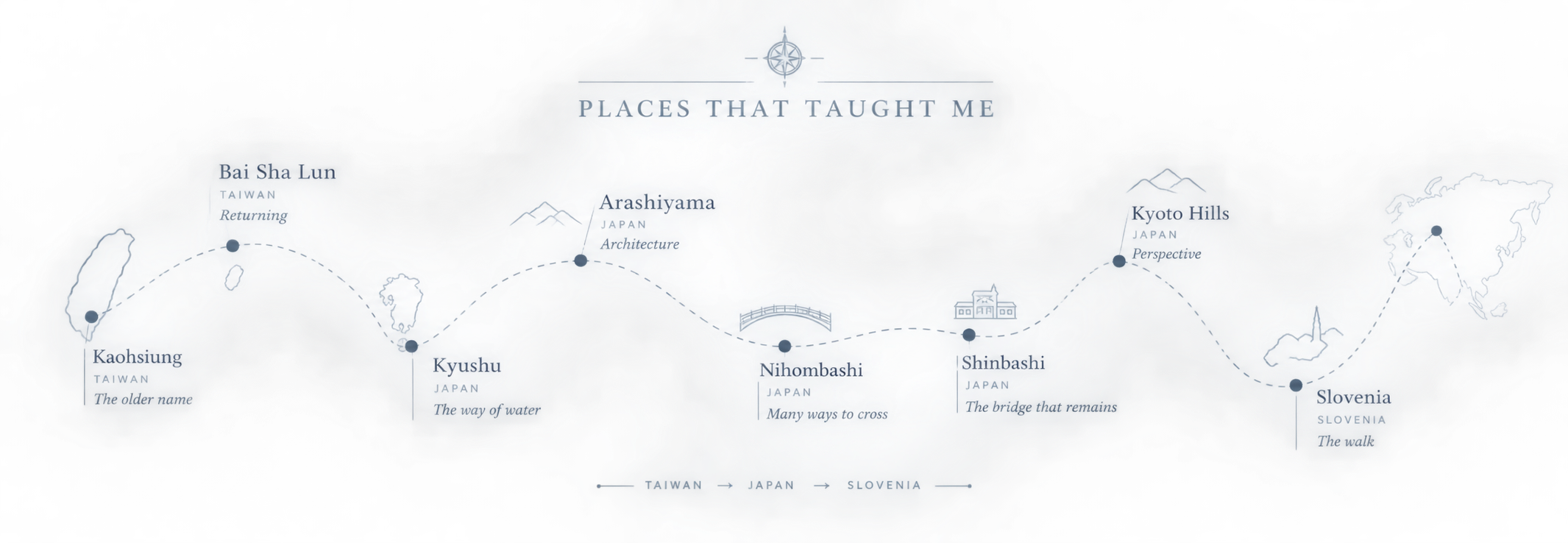
Places that taught me
I think in stories before I think in frameworks, and the stories that stay are the ones with a place in them.

The path through the bamboo.
ARASHIYAMA, KYOTO, JAPAN
A formula prescribes; an architecture enables. Every framework on this site is meant to be a path through bamboo, not a set of instructions for walking.
LEAD with Clarity, chapter 7
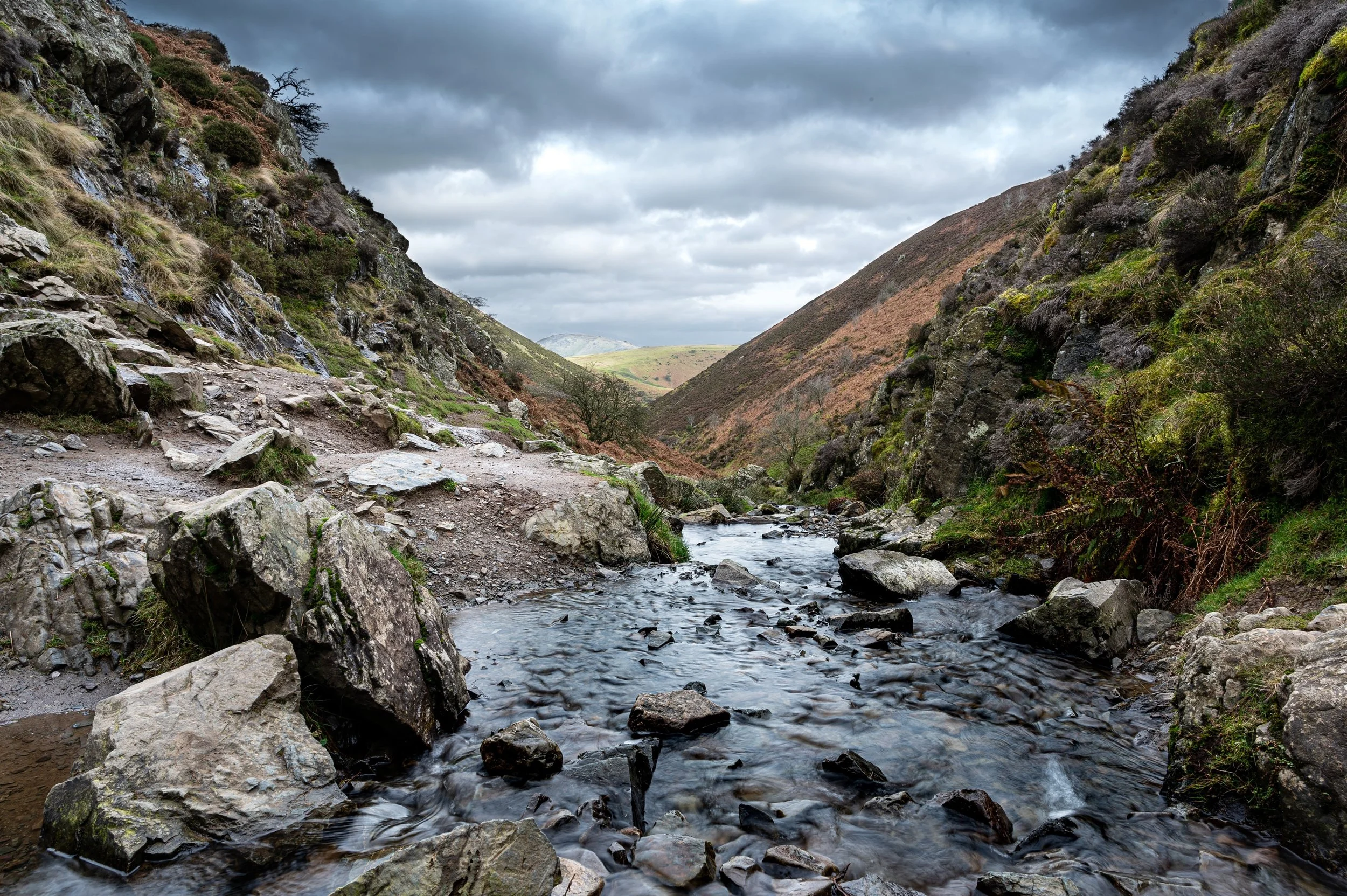
The river and the boulder.
LEAD with Clarity, chapter 29
Where the river met a boulder that must have weighed tons, the water had carved a smooth channel around it. What brute force could never accomplish, patient flow had achieved.
LEAD with Clarity, chapter 30
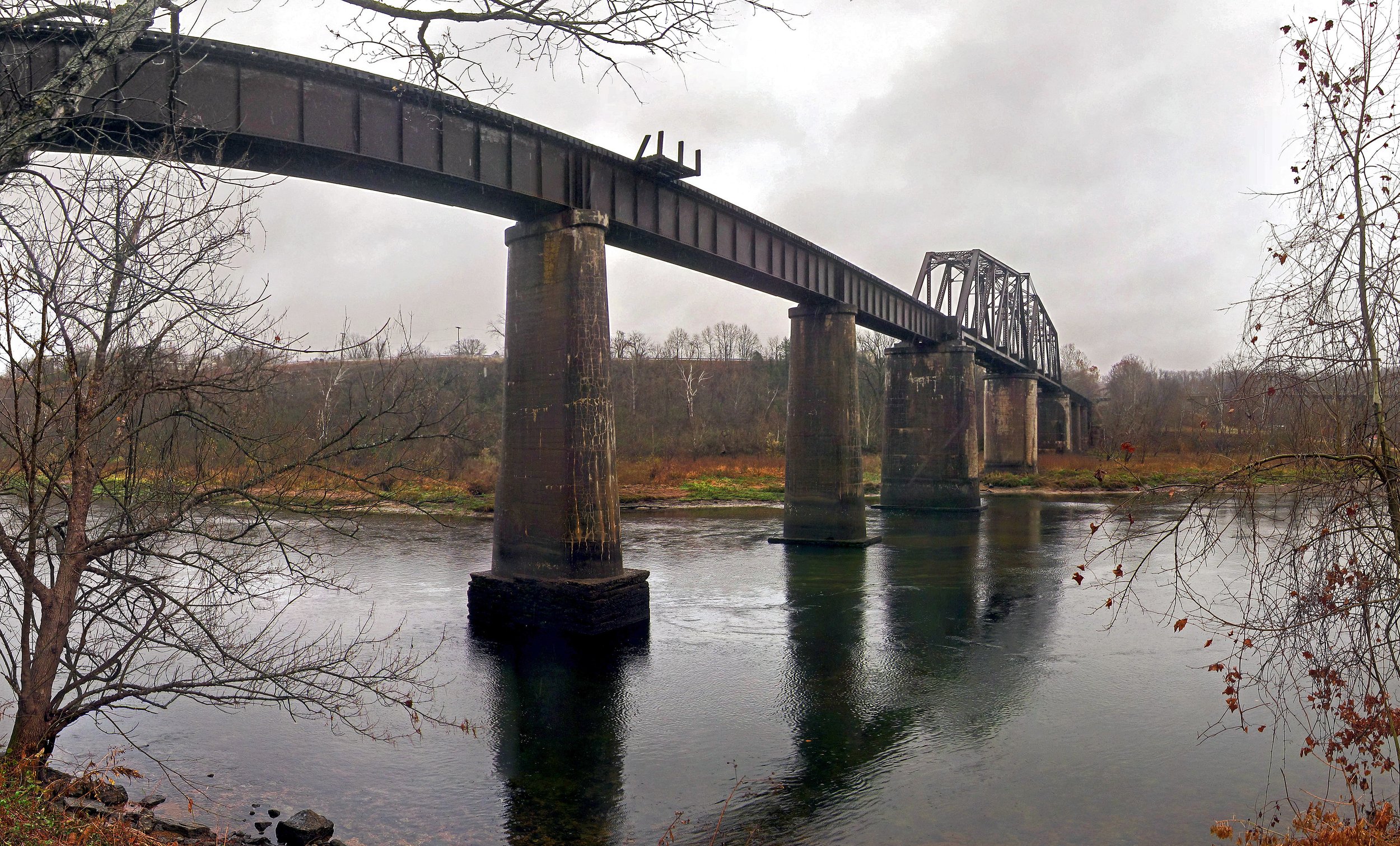
The bridge with many crossings.
LEAD with Clarity, chapter 29
Four centuries of ways across, stacked on one spot. There is never only one bridge. There are always multiple ways to cross.
LEAD with Clarity, chapter 29
The Architecture of Experience →

The traveller from another world
Worlds within worlds
Every person who sits before us in coaching carries worlds. The Japanese storytellers have a whole genre, isekai, about a person who wakes in a different world and must learn its rules or fail;
From LEAD with Clarity, chapter 9
Worlds Within Worlds →
The bridge that is no longer there.
SHINBASHI, TOKYO, JAPAN
Shinbashi means "new bridge." The bridge is gone; the river it crossed was filled in long ago, and what remains is a district, a station and a name. Japan's first railway left from here in 1872, and the salarymen still pour out of the station every evening as if the bridge were still under their feet. I go there for the lesson the place gives without trying: a crossing can outlive the bridge that made it. The habits a leader built to cross an old river keep being walked long after the river is gone, and part of the work is to ask, gently, what the bridge was for.
The old name of the harbor.
Kaohsiung was Takao before it was Kaohsiung, and before that it was Takau, a word from the Makatao people of the plain that is usually read as "bamboo forest." The Japanese kept the sound and changed the characters in 1920; the city kept the harbor and changed everything else. I have sat in boardrooms in Kaohsiung more times than I can count, and the name is the lesson: under every present name there is an older one, and under the older one a forest. Most leaders are managing the current characters. Coaching, when it works, gets down to the sound.
TAKAO, KAOHSIUNG, TAIWAN
The shore I keep returning to.
I go back to this beach more often than I go back to any other place. It is not a beautiful beach in the way a brochure means beautiful. The sand is coarse and grey-white, the shore shelves out so gently that the water takes a long time to get deep, and the working world is never far away: fishing boats, a road, the shape of industry somewhere down the coast. What it has is the west-facing sea, which means it has the whole of the sunset, and it has a tide that goes a long way out and comes a long way back.
I walk it at the end of a teaching week, when I have been talking for four days and have nothing left to say. That is the point of it. There is a stretch where the wet sand holds the sky so completely that you cannot tell where the beach ends, and you find yourself walking on the clouds you are looking at. I have made more decisions on that stretch of sand than in any office I have ever sat in. Not by thinking harder. By stopping the thinking and letting the tide do what it does, which is to come back whether or not I have resolved anything.
That is the lesson I take from it, and I give it to leaders who are trying to force a resolution out of a week that does not have one. The tide does not argue with the shore. It simply keeps coming back. Most of what we are trying to solve by pushing will be solved by returning.
BAI SHA LUN, ON THE COAST SOUTH OF TAINAN AND KAOHSIUNG, TAIWAN
The walk above the valley.
THE MOUNTAINS OF SLOVENIA
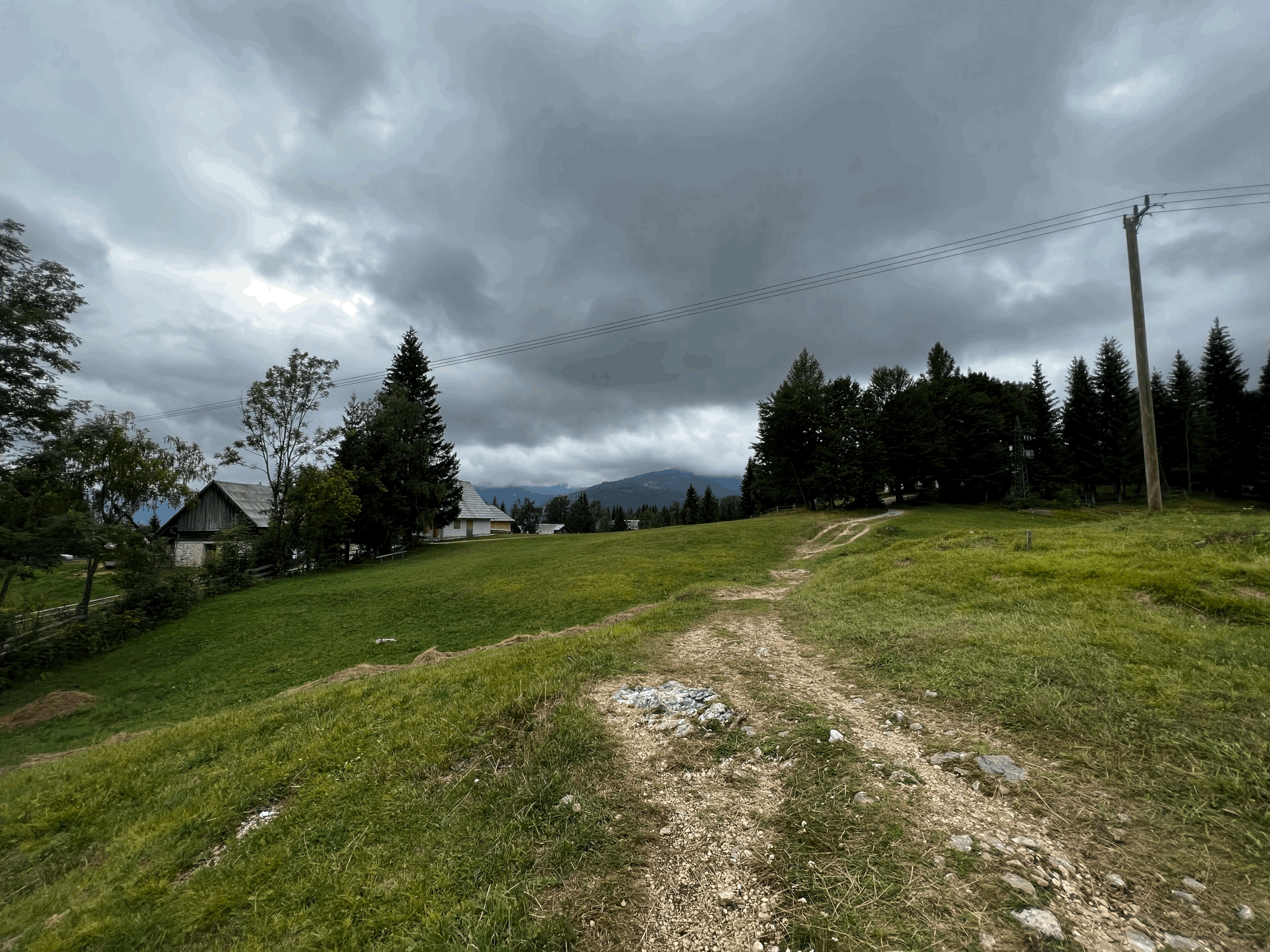
The leadership retreat I run in Slovenia does most of its work outdoors, and the walk is not a break in the programme. It is the programme. We go up in the morning, and for the first hour a leadership team behaves exactly as it does in a meeting room: the same people talk, in the same order, at the same volume, about the same things. Then the path gets steeper, and the talking stops, because breathing takes priority over positioning.
What happens next is the reason I keep doing it. Somewhere above the tree line, where the valley opens out below and the lake is a coin of light and the far ridges go blue with distance, people start saying true things. Not because I asked a good question. Because the landscape has made the meeting room look small, and it is difficult to defend a small position in a large place. I have watched a team tell each other, on a mountain, what they had not managed to tell each other in eighteen months of Thursdays.
Then we come down, which is its own lesson. Everything that is said up there has to survive the descent and the coffee and the return to work, and a good retreat spends as much care on the coming down as on the going up. A mountain does not give advice. It just keeps showing you how far you have come, and how far you can see from here.
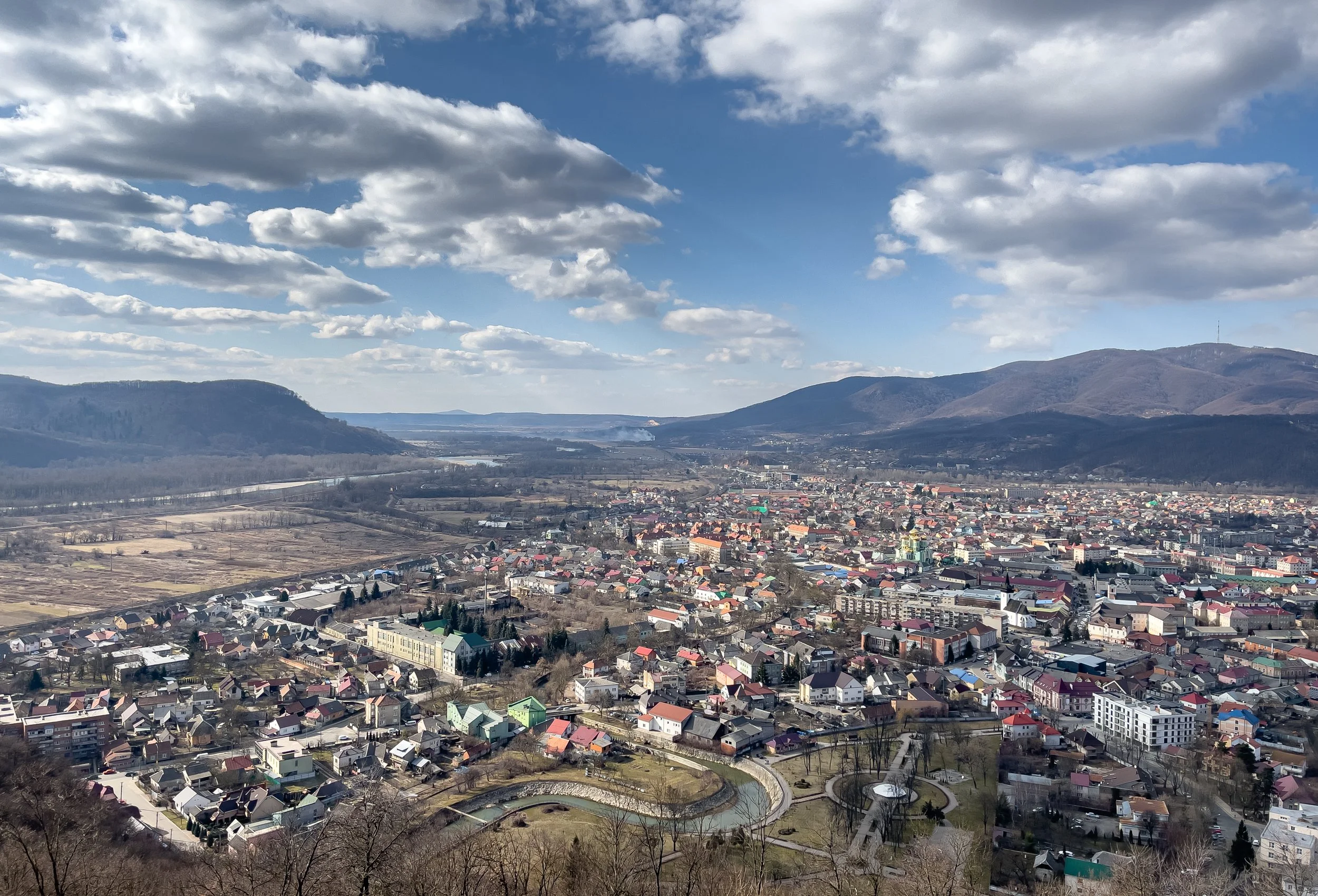
The mountains above the city.
THE HILLS OF KYOTO, JAPAN
Kyoto is a city held in the palm of its mountains: Higashiyama to the east, Kitayama to the north, Arashiyama to the west, a bowl with one open side. Walk up out of the streets for forty minutes and the city becomes a map of itself. What the mountain teaches is altitude: the same situation looks different from higher up, not because it changed but because you can now see where it sits. I bring leaders up mountains, in fact or in conversation, for that reason.
The way of water
Water is the softest thing, yet it can penetrate mountains and earth… The master coach learns from water: yielding yet persistent, gentle yet powerful, formless yet shaping everything it touches.
Mizu is the Japanese word for water, and the way of water is the closest thing I have to a philosophy of practice. It came from a river in Kyushu and a boulder the river had gone through.
Flow
The flowing coach moves with the conversation rather than forcing it.
Adaptability
Water takes the shape of whatever contains it and remains water. The adaptation is in expression, not in essence.
Persistence
The persistent coach trusts the cumulative work, approaching the same challenge from countless angles over time
Depth
The depth-seeking coach moves toward what is fundamental, and is willing to stay in the valley.
Clarity
The clarifying coach holds a still space in which a person's turbulence can settle.
Nourishment
The nourishing coach knows the difference between feeding someone and flooding them.
Power
Power is available and used rarely, precisely, and never as a habit.
Force moves what is loose. Water moves what is fixed.
Books to begin with
-

LEAD with Clarity
The Architecture of Conversational Mastery. The reference volume for the LEAD Coaching Model.
-

LEAD Where You Stand
The coaching conversation playbook for the leader you are becoming.
-
Coaching Is Conversational Mastery
The hidden discipline behind conversations that change lives.
-
PUTURE
A new way of seeing for coaches, leaders and the people they serve.
-
Brave Your Story
Where the human's conversation begins.
Frameworks, research and practice
Frameworks. Four ideas carry most of the work, and each has its own page; the models and principles inside the lines are in the grid above. Beneath them sit some forty named techniques, each defined in two sentences on one page, none of them a brand. The frameworks page is the working set; it is where a technique lives until it has earned a page of its own.
Framework →
Research. I am a practitioner, not an academic, and the research shelf says so. Every entry carries a type (concept note, literature review, working paper), a status, a version and a date, and a line about what it does not show. Where no independent evidence exists yet, the page says so and says what would count.
Research →
Practice. Some of the skills in these pages can be practised alone, in five minutes, this week. The practice library holds those pages; participants in my programmes scan into them from the workshop room.

Bringing these ideas into a room
The ideas here were made in rooms, and rooms are still where they do their work. Coaches, leadership teams and organizations bring me in for the ideas rather than for a programme off a shelf, and the engagement usually begins with one of three questions.
For a leadership team or an organization.
The question is usually "what would it take for our conversations to be as good as our strategy?" The work is a keynote or a working session on one idea, followed, when it is wanted, by coaching for the people who have to carry it.
For a coach.
The question is usually "what develops in me next?" The work is mentor coaching, supervision, or coaching on the journey of mastery: a season of conversations in which your own practice is the material.
You can only take people where you have travelled.
For a person.
The question is rarely a question at first. It is a sense that the future being projected is smaller than the life. The work is coaching, one to one, over months.
How this work is disclosed.
Three layers. The definitions, diagrams, worked examples and boundaries on these pages are public and free, and the definitional sentence and diagram of each framework may be quoted with attribution. The teaching, the component-by-component method, the workbooks and the annotated transcripts, lives in the books and in the programmes. Facilitator guides, assessment rubrics and the full taxonomy are provided to licensed faculty and partners and are not published. If you are quoting an idea from this site, each page ends with a citation line. The site is the canonical source and the version on the page is the current one.
Changelog: [date]: version 2, the essay and the map. [Earlier date]: version 1, the map.