

Ideas › CATS
CATS: Curiosity-Based Listening
By Jedidiah Alex Koh · Version 1.0 · Revised [date] · The leader's conversation
In-page contents: The four dimensions · The two axes · WHO before WHAT · What it is not · A worked example · What the listener observes · Origin · Evidence
Definition
CATS is a curiosity-based approach to listening, developed by Jedidiah Alex Koh, in which one curious posture is held across four dimensions: C, the curiosity of context and content; A, apprehending apprehensions; T, tracing the train of thought; and S, sagacious stillness that sees.


For coaches, supervisors, mentor coaches and leaders who have noticed that their listening has become the bottleneck.

For coaches, supervisors, mentor coaches and leaders who have noticed that their listening has become the bottleneck.

For coaches, supervisors, mentor coaches and leaders who have noticed that their listening has become the bottleneck.
Why it exists
I have sat with several hundred recorded coaching conversations as a mentor coach and an assessor, and the failure I hear most often is not a bad question. It is a good question asked from an incurious place. The coach has already decided what the conversation is about. The question is technically clean, correctly open, properly phrased, and the person on the other end can feel that it is being asked by someone who is no longer curious. They answer it accurately. Nothing moves.
The training most of us received made this likely. We were taught the moves of listening: nod, paraphrase, summarize, reflect back, ask the open question. The moves are real and they are not the thing. A person can perform every one of them while waiting for a turn to speak, and most people can tell when that is happening, which is why so much skilled listening produces so little. We were handed the costume and told it was the body.
CATS exists because curiosity is the part that cannot be performed, and because saying so is not enough. A stance that cannot be named, taught, practiced or assessed stays a virtue, and virtues do not survive pressure. So the posture is broken into four dimensions that can be learned separately, watched separately, and assessed separately, and then put back together into the one thing they were always part of. The four are a way in. They are not the thing either.
The framework
The CATS™ Compass by Jedidiah Alex Koh, a diagram showing four dimensions of curious listening placed in the quadrants of two axes. The vertical axis runs from Stance to Action, the horizontal axis from the WHAT to the WHO. C, the curiosity of context and content, sits at Stance and the WHAT. T, tracing the train of thought, sits at Action and the WHAT. A, apprehending apprehensions, sits at Action and the WHO. S, sagacious stillness that sees, sits at Stance and the WHO. The person sits at the center where the axes cross, and curiosity is named above the whole frame as the canopy.
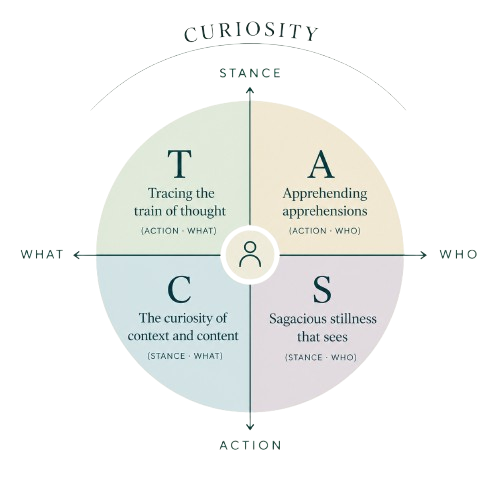
The CATS Compass, version 2.0, 2026. Jedidiah Alex Koh. Definition and diagram licensed CC BY-NC-ND 4.0; the name CATS is used as a trade mark and is excluded from the license.
The diagram is a compass rather than a sequence. Two axes cross. The vertical axis runs from stance at the top to action at the bottom, separating what a listener is from what a listener does. The horizontal axis runs from the WHAT on the left to the WHO on the right, separating the matter a person brings from the person who brought it. The four dimensions fall one to a quadrant. C is a stance toward the WHAT: taking in content and context without reaching. T is an action on the WHAT: following the thinking as it moves.
The four dimensions
Curiosity of Context and Content
Attends to the actual words chosen and the field they were said in. A move: keep three charged words and give one back untranslated. Failure: content greed, or context blindness.
Apprehending Apprehensions
Senses what's held back inside the decision it arrives folded in. A move: name the brace as a guess, not a verdict. Failure: the confident diagnosis that makes the room unsafe.
Tracing the Train of Thought
Follows the person's reasoning — its couplings, its track, what powers it — without taking the controls. A move: reflect the thread back. Failure: finishing their sentence.
Sagacious Stillness That Sees
Stays in not-knowing long enough for the person's WHO to come into view. A move: hold silence one breath past comfort. Failure: the rush to closure, or psychologizing.
The two axes
The four are not a checklist. They are a compass with two axes, and the axes are the part that does the diagnostic work. The first runs between stance and action. C and S are stances, ways of being oriented; A and T are acts, things done in the conversation. A listener who is all action and no stance becomes an interrogator, efficient and unbearable. A listener who is all stance and no action becomes a warm fog, pleasant and useless. In every cohort I have taught, most people are lopsided in one direction, consistently, and can say which within a minute of being asked.

The second axis runs between the WHAT and the WHO. C and T point at the matter: the terrain and the thinking. A and S open onto the person: the guarded self and the self seen. Under pressure, listening collapses toward the WHAT almost without exception, because the WHAT is where competence lives and competence is what we reach for when we are anxious. The whole training is the return.
C is a stance toward the WHAT.
T is an action on the WHAT.
A is an action toward the WHO.
S is a stance toward the WHO.
WHO before WHAT
Every problem arrives carried by a person, and we keep taking the problem and putting the person down. That sentence is the whole of it. Two questions are present in every difficult conversation, running together like two frequencies on one signal: what is the matter here, and who is the person carrying it. Both are real. Only one of them is usually answered.
The cost of getting this wrong is not that the problem goes unsolved. Problems get solved all the time in conversations where nobody was met, and the solution does not hold, because the person who has to carry it was never in the room. Ask anyone to describe a conversation that changed something for them and they will describe being seen, not being advised. I have asked that question in rooms in Singapore, Taipei and Tokyo and the answers do not differ. We know this as people and forget it as professionals, usually at the exact moment our competence is most available to us.

WHO before WHAT is not a rule that the person must be discussed before the problem. It is an order of attention, not an order of topics. A conversation can stay on the restructuring, the resignation, the budget, the whole hour, and still be a conversation in which the person was the thing being listened to. The reverse is also common and worse: a conversation full of feeling words in which nobody was actually seen.
What is not
Not active listening renamed
Active listening is a set of behaviors — attending, paraphrasing, reflecting. CATS is not a replacement set of behaviors. It is the posture those behaviors are supposed to prove, and the claim is: worthless without it, unnecessary with it.
Not a levels model
Co-Active teaches three levels; Scharmer four, from downloading to generative — ladders where higher is better. The CATS Compass has no ladder. The four dimensions are unranked; the question is which one went missing, not how high you got.
Not the person-not-the-problem move
Marcia Reynolds made that case in 2020; the WHO-before-WHAT move shares her conviction, not her discovery. What CATS adds is mechanism — what a listener is doing, dimension by dimension, in the seconds the turn is made or missed.
Not a questioning technique
Most listening training is question training in disguise. This teaches reflection, silence, restraint. The most reliable instrument is saying nothing one breath longer than is comfortable — less a technique than the absence of one.
Not primarily an acronym about cats
The acronym is a handle; the animal is a teaching image — interest that does not grab, attentive and unhurried, tracking without lunging. The image opens and closes the work and is rationed in between. If it's doing the prose's work, the prose failed.
A worked example
A regional director, six weeks into a role she moved countries for, spends the first ten minutes on a reorganization. Reporting lines, two teams merging, a country head who has not replied to her last three messages. It is all accurate and none of it is why she is here.
She says, near the end of a long sentence about the structure: it is fine, I just do not want to be the person who comes in and changes everything.
The content is the reorganization. The context is that she is six weeks in, in a country not her own, describing herself in the third person as a type of person. That is C: the word person, chosen twice, held against the room it was said in.
I do not ask what she means. I give one of her words back. The person who comes in and changes everything.
She is quiet for a while. That silence is S, and the only skill in it is not filling it. Then she says: in my last company they called someone that. It was not a compliment.
The train is visible now. The coupling is the leap from I have authority here to I will be seen the way he was, joined by a therefore nobody has examined. Tracing it does not mean arguing with it. It means making the join visible. You went from having the mandate to change things straight to being that man. Is that one step or two?
What she has not said is the apprehension, and it is not about the structure. She is afraid of being read as the outsider who arrived and rearranged. Apprehending it means offering it loosely, as a guess she can refuse. It sounds as though the part you are weighing is not what to change but what changing it will make you here.
She corrects me, which is how I know it landed near enough to be worth correcting. Not what it makes me. What it makes me to them.
Nothing has been solved. The reorganization is exactly where it was at minute one. But the conversation is now about the thing it was always about, and it took four dimensions and almost no questions to get there.
What the listener observes
Most listening training names the attending and skips the observing, which is half the skill. Beneath what a person says runs a second stream of what they show, and a curious listener watches it the way a cat watches a garden — not scanning for a signal, simply available to whatever moves.
| Dimension | What to observe and wait for |
|---|---|
| C | Actual words over gist; what's named or conspicuously absent; repetition; the cast of people and systems mentioned; sequence and timeline; the topic they keep circling back to. |
| A | Tone shifts and the catch in the voice; what's softened, rushed past or laughed off; self-protective phrasing; the held breath; the unnecessary apology; words at odds with the feeling beneath them. |
| T | Logical joins and leaps dressed as therefore; the metaphors reached for; pronoun shifts (I → you → one → we); verb tense and modals like should, must, have to; where thinking speeds up, stalls or forks. |
| S | Energy shifts — what lights them up, what deadens them; whole-body posture; identity statements; values surfacing; whether a silence is full or empty; the moment something true lands. |
One caution: the familiar claim that 93% of communication is non-verbal misreads a pair of narrow Mehrabian studies about feelings and attitudes when words and tone conflict. Tone and body carry real weight for affect — but no fixed percentage exists, and a book about noticing shouldn't shelter a tidy false statistic.
Where it applies, and where it strains
Where it applies
One-to-one coaching, the listening practice powering Examine, Explore, and Evoke in the LEAD model.
Team coaching, where the WHO is collective and the apprehension is usually held by whoever hasn't spoken.
Coaching supervision, where the curiosity turns on the practitioner's own work and the parallel process is traced.
Leadership, in the one-to-one, the town hall and the corridor — the higher a person rises, the less truth reaches them.
Where it strains
Time. A twenty-minute conversation with a decision due pulls hard toward the WHAT — one breath of S still changes what the decision is made of.
Difference. The dimensions don't change, but their expression does: a silence read as respect in one room reads as abandonment in another.
Depletion. You cannot hold a space wider than the one inside you — a coach's fourth session of the day shows up in the recording.
Origin and inheritance
CATS™ was developed between 2019 and 2026, out of curiosity and assessment rather than out of theory. What I saw in the recordings was that real movement didn't come from the questions, but from staying curious a moment longer.
The inheritances come from established work in psychology, communication and learning. Each part is named because it isn't mine. The ingredients are not repeated here - they are attributed by name in the references and endnotes.
What's added is the organization: curiosity as a four-dimensional listening posture, arranged by a stance-to-action and WHAT-to-WHO cross-axis, so it can be taught, practiced and assessed at transcript level.
CATS fits with LEAD as the listening that walks through its rooms. LEAD gives the conversation its shape; CATS does the hearing. You don't need LEAD to use this, and the book says so on its second page.
In the author's words
-
CATS: Curiosity-Based Listening, in preparation — The thesis, stated in the Introduction
-
CATS: Curiosity-Based Listening, in preparation — Chapter one, The Cat at the Window
-
CATS: Curiosity-Based Listening, in preparation — Chapter two, The Listening We Were Taught
-
CATS: Curiosity-Based Listening, in preparation — Chapter four, WHO Before WHAT
-
CATS: Curiosity-Based Listening, in preparation — Chapter five, C, the Curiosity of Context and Content
-
CATS: Curiosity-Based Listening, in preparation — Chapter six, A, Apprehending Apprehensions
-
CATS: Curiosity-Based Listening, in preparation — Chapter seven, T, Tracing the Train of Thought
-
CATS: Curiosity-Based Listening, in preparation — Chapter eight, S, Sagacious Stillness that Sees
-
CATS: Curiosity-Based Listening, in preparation — Chapter nine, The Four in Concert
-
CATS: Curiosity-Based Listening, in preparation — Chapter ten, The Enemies of Curiosity
-
CATS: Curiosity-Based Listening, in preparation — Chapter eleven, The Discipline of Not-Knowing
-
CATS: Curiosity-Based Listening, in preparation — Chapter twelve, CATS in the LEAD Conversation
Evidence
No independent study of CATS has been published, and none is in progress. What exists is the underlying literature, which is uneven and should be described as it is. Rogers's conditions and Kline's account of attention are long established and widely taught. Kashdan's dimensional model of curiosity is empirically grounded. Kruglanski's need for closure is a well-replicated construct. Guy Itzchakov and Avraham Kluger's experiments on high-quality listening, which show that being listened to well lowers a speaker's social anxiety and defensive processing and deepens their self-insight, are the closest thing to direct support for the claim this approach makes, and several of those findings are associational rather than causal. The book says so in the sentence where it uses them. Until that exists, the honest description of this page is that it is a practitioner's synthesis, grounded in named research and tested against several hundred assessed conversations, and that the assessment base is mine and therefore not independent.
What would count as evidence
Transcript-level study
Independent raters, blind to condition, score the presence of each dimension and relate it to a client-reported outcome.

Comparison of trained coaches
Coaches trained in this approach vs. conventional active-listening curriculum, measured on something other than satisfaction.

Replication across languages
At least two language groups, because every dimension varies
by culture.

Where it is taught

CATS is taught in the Level 1 and Level 2 coaching programmes, and the supervision and mentor-coaching applications are taught in Confluence and in Resonance.
Go further
The Window Minute·the listening practice page
Practise it
This is the listening that powers Examine and Explore and Evoke inside the LEAD Coaching Model
Inside the architecture
CATS: Curiosity-Based Listening. Holding Space for the Human Behind the Story. In preparation
The book
CATS sits among the working set with its neighbors on the frameworks page
Related entries
Recent reflections
How cite this
Koh, Jedidiah Alex. "CATS: Curiosity-Based Listening." Version 1.0, [date].