
Ideas > Metaphorium™
Metaphorium™
Metaphorium is the design exploration of the interior, a discipline developed by Jedidiah Alex Koh: building a small world you can enter, out of whatever material is to hand, in order to learn something the mind cannot reach head on.
BY JEDIDIAH ALEX KOH
FOUNDER, JEDI.COACH
What is Metaphorium™
Some experiences can be described accurately and still remain untouched. A person can talk about a difficult relationship for an hour and become more fluent in the story without getting any closer to what it is like to live inside it. The words keep arranging the surface.
Then the person says, almost in passing, ‘It is like carrying a piano up a staircase.’ A small world appears. There is a piano, a staircase, weight, effort and a top that cannot yet be seen. The person can notice where they are standing, what the piano is made of, who is missing from the other end and whether the stairs were ever the only route. The conversation has somewhere to go.
I have watched this opening happen across many years of coaching. I wrote the first edition of Metaphorium in 2017 because I wanted to name what I thought was happening. That edition introduced the phenomenon but did not yet give it a full discipline. The new edition in preparation develops the definition, movements, motions, principles, materials and testable claims. This page gives readers the shape. The book carries the fuller argument and practice.

“Sometimes a person has explained the problem clearly and still has not entered it.”
How Metaphorium™ works
Metaphorium moves in a loop. Going In translates the world as first given into an interior that can be explored. Staying In develops the small world without forcing an early explanation. Bringing Back returns what has been learned to the relationship, choice or situation outside. The return may change the next entry, so the loop can begin again.

Going In
Translates the world as first given into an interior that can be explored.


Staying In
Develops the small world without forcing an early explanation.

Bringing Back
Returns what has been learned to the relationship, choice or situation outside.
The three movements
Going In
A problem often arrives with a frame already inside it. The frame may be a battle, a wall, a race, a burden or a road with no turning. Nobody deliberately chose it, yet it has begun deciding which questions sound reasonable and which solutions can be seen.
Noticing makes the frame visible. Entering means treating the image as a place with properties rather than a phrase that needs immediate interpretation. Ask what the staircase is made of, how narrow it is, whether there is a landing and where the person is standing. Meaning can wait. The material gives the conversation somewhere to begin.
Sample question
What is the staircase made of?
Staying In
Inside the small world, the person begins to build. They may add detail in words, sketch a shape, place objects on a table, change the distance between two pieces, find a sound, or notice how the image sits in the body. Making gives the world enough form to be explored.
Holding is the discipline of staying without taking over. The practitioner keeps the image available, notices when it is being stretched beyond what it can carry, and resists the pleasure of offering a clever interpretation. An image is entitled to hold only what it can hold. Restraint protects the person's ownership of the world.
Sample question
Stay with the piano. What does it weigh, exactly?
Bringing Back
The interior is useful because the person will return to a larger world. Releasing allows the image to finish without squeezing it for one final lesson. Integrating asks what the person can now see, say or do in the relationship, decision or week ahead.
A metaphor kept too long can become a hiding place. A metaphor brought back too quickly becomes a slogan. The timing matters. The practitioner listens for the point at which the world inside has given enough and the world outside needs the person again.
Sample question
When you are back at your desk on Monday, what is different?
"A small world earns its place when it changes how the person meets the larger one."
Suggested pull quote — for author approval
Core Principles of
Metaphorium™
Begin with the material
Ask what the image contains before asking what it means. Texture, distance, weight, temperature, sound and position often reveal what an abstract explanation would close too early.
Treat meaning as something the person builds
There is no universal dictionary in which a staircase, river or locked room carries one fixed meaning. The meaning grows from this person, this world and this conversation.
Enter before interpreting
Interpretation stands outside an image and explains it. Entering lets the person look from within it. The difference is practical: one produces an account, while the other can create a new position from which to notice.
Keep ownership with the person
The practitioner may ask, reflect, offer material or sometimes supply a metaphor under restraint. The small world still belongs to the person who must live with what it reveals.
Offer a metaphor with permission and restraint
A supplied image should be offered lightly, with room for refusal, revision or replacement. If the person has to accept the practitioner's image in order to continue, the conversation has become an act of persuasion.
Let an image hold only what it can
A useful image has limits. When every detail is made to prove the same conclusion, the practitioner is no longer exploring the world; they are making it obey.
Change material when words have run out
A person may know more through a sketch, an arrangement of objects, a gesture, a rhythm or the felt layout of a room than they can yet say in a sentence. Changing material is not decoration. It changes what can be noticed.
Return to the world outside
The purpose is not to produce a beautiful metaphor. The work has to meet the conversation that brought the person here. Integration may be a new sentence, a boundary, a decision, a request or simply a more accurate way of seeing.
Optional quote bank
- "If I tell you what your metaphor means, I have left your world and entered mine."
- "The image belongs to the person who has to live with what it reveals."
- "A metaphor can be precise without becoming literal."
The movements describe where the conversation is. The principles describe how the practitioner behaves while the work is happening. They are disciplines of attention and restraint rather than steps to complete
The materials
People build in different materials, and the material changes what becomes available. Some think through words and sentences. Others reach first for pictures, objects, sound, movement or the arrangement of space. Clay, blocks, a song, a garden, a kitchen or a room can each become part of a small world when that is where the person's thinking has gone.
In my teaching, I sometimes contrast a recipe followed by weight and time with a kitchen guided by sight, smell, taste and the feel of the heat. The point is not that one culture cooks in only one way. It is that precision and embodied judgement can both produce disciplined work. Metaphorium needs the clarity of a method and the responsiveness of a craft.

What Metaphorium™ is not
It is not Clean Language
David Grove's Clean Language, developed through the work of James Lawley and Penny Tompkins into Symbolic Modelling, offers a non-directive way to elicit and develop a person's own metaphors. Metaphorium acknowledges that lineage and departs from it at a specific point:
It is not a metaphor dictionary
There is no approved list of what a staircase, storm or doorway means. Meaning is made by the person inside the particular world that has appeared. A ready-made interpretation may sound wise while removing the very inquiry the metaphor opened.

It is not an invitation to remain vague
The discipline has a definition, movements, motions, principles and an account of its limits. The new edition also sets out predictions that can be tested. Imagination does not remove the need for precision; it changes where precision is applied.
It is not Metaphor Craft
Metaphor Craft is the coaching-room companion: the session-level practice, techniques and decisions used in a single conversation. Metaphorium is the parent discipline: the philosophy, materials and movement between the interior and the world.
A WORKED EXAMPLE
The piano on the staircase
A leader comes to coaching because the team has stopped taking initiative. They have explained the problem several times: deadlines are tight, the team waits for direction and every decision comes back to the leader. The account is clear. It has also begun to repeat itself.
Halfway through the conversation, the leader says, ‘It feels like carrying a piano up a staircase while everyone watches from below.’ The coach does not ask what the piano represents. Instead, the coach asks, ‘What is the staircase made of?’
The leader pauses. The staircase is polished stone and too narrow for two people to stand beside each other. There is no landing. The piano is older than the building and belongs to the organization. The leader is carrying it backwards, looking down at the people below rather than towards the floor above. This is Going In. The image has moved from a familiar complaint into a place with material, direction and constraint.
The coach asks the leader to use objects on the table. A notebook becomes the staircase. A heavy water bottle becomes the piano. Small pieces of paper mark the team. When the leader places everyone at the bottom, they notice that nobody has been asked to take a position anywhere else. The instruction has always been to watch and wait.

“The conversation changed when the leader stopped explaining the staircase and began to notice where everyone was standing.”
Where Metaphorium™ applies
Metaphorium applies wherever a person is trying to understand something that description alone has not reached. It can support coaching, supervision, therapy, counselling, facilitation, teaching and private reflection. It is especially useful when a person already speaks in images, when the conversation has become repetitive, or when the problem's frame is quietly deciding what can count as an answer.
The work does not require artistic skill. The material can be plain and temporary. A rough sketch, three objects on a table or one carefully held phrase may be enough. What matters is whether the person can enter the world and learn from the relations inside it. In therapy or counselling, Metaphorium should be used only by appropriately qualified professionals, within their scope of practice and with attention to the person's care context.

The discipline strains when a person needs an immediate decision more than an exploration, when imagination becomes a way to avoid material consequences, or when the practitioner supplies images faster than the person can refuse or reshape them. It also strains when a metaphor intensifies distress or makes it harder for the person to remain oriented to the present.
Origin evidence and lineage
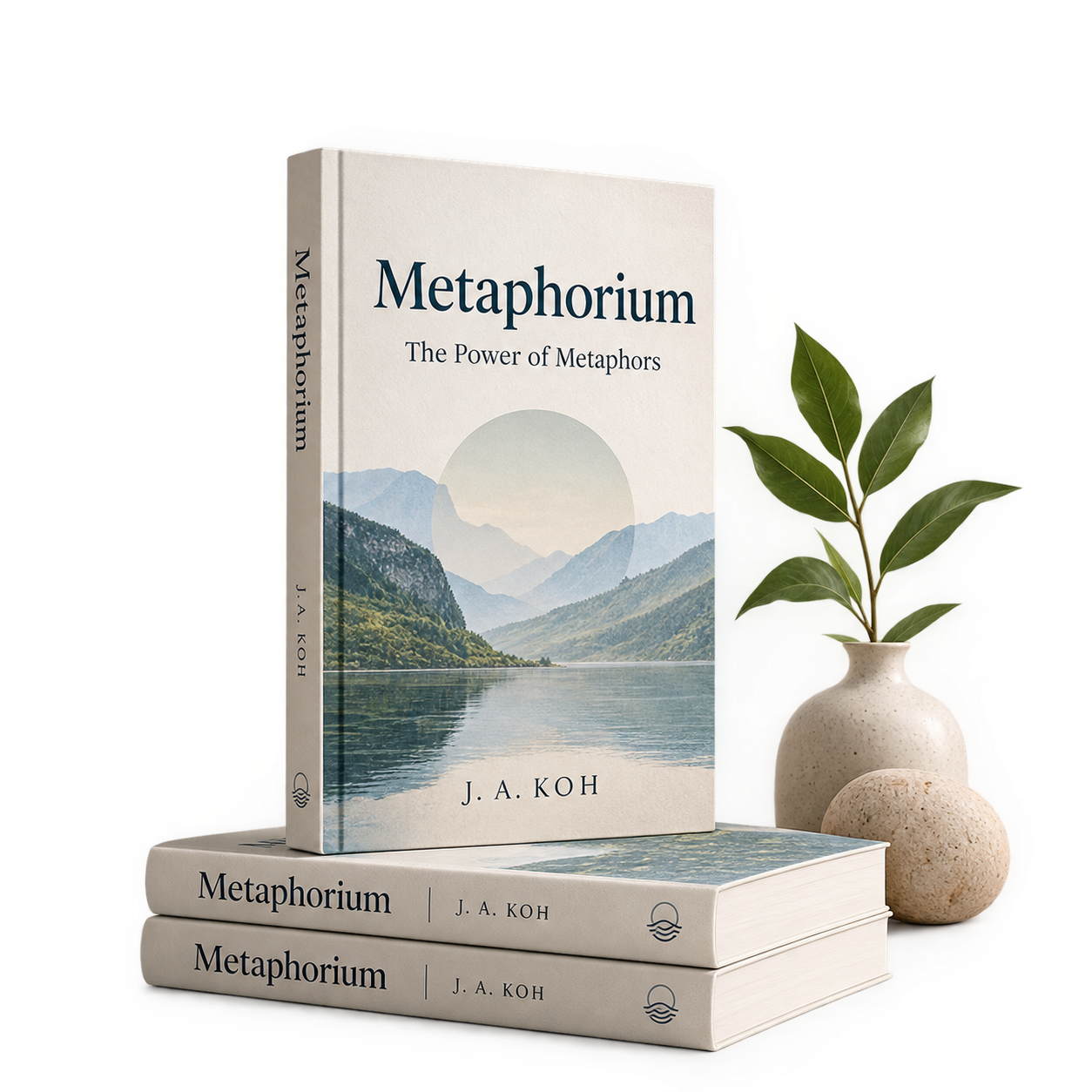
The first edition, Metaphorium: The Power of Metaphors, was self-published in 2017. I wrote it to name a way of working that had been present in my coaching for years. The current definition belongs to the revised discipline developed for the new edition, Metaphorium: The Design Exploration of the Interior, which is in preparation.
In September 2020, I also published a Forbes Coaches Council article on Metaphorium and the use of metaphor in teams. I link to it here as part of the provenance. It records an earlier public account of the idea; the 2026 definition on this page is the current one.
The inheritance is wider than my own work. Conceptual blending, in Gilles Fauconnier and Mark Turner, helps explain how minds construct temporary blended spaces. Clean Language and Symbolic Modelling provide a disciplined non-directive practice for eliciting and developing metaphor. Donald Schön examined how a frame shapes the problem before solutions are proposed. Richard Kopp offered a client-generated approach to metaphor in therapy, and Lynne Cameron studied how metaphor works in discourse. The expressive arts show how meaning changes when it moves between materials.
Metaphorium brings these lines into one discipline and makes four claims for its own contribution: an indication for when metaphor may be useful, a defence of deliberate supply under restraint, a way of holding an image to its limits, and predictions that can be shown wrong.
What evidence exists
The current record consists of the 2017 book, the 2020 article, the practice from which the discipline developed and the established bodies of work named in its lineage. These sources establish provenance and give the discipline an intellectual context.
What evidence exists
The current record consists of the 2017 book, the 2020 article, the practice from which the discipline developed and the established bodies of work named in its lineage. These sources establish provenance and give the discipline an intellectual context.
What evidence exists
The current record consists of the 2017 book, the 2020 article, the practice from which the discipline developed and the established bodies of work named in its lineage. These sources establish provenance and give the discipline an intellectual context.
Go deeper in the book
This page introduces the definition and movement of Metaphorium. The book is where the discipline can be studied in full: its principles, materials, lineages, predictions, examples and the choices a practitioner makes while working inside a small world.
The 2017 first edition, Metaphorium: The Power of Metaphors, records the earlier form of the work. A new edition, Metaphorium: The Design Exploration of the Interior, is in preparation. To read the edition currently available, follow the Amazon link below.

References
1. Koh, J. A. (2017). Metaphorium: The Power of Metaphors. First edition, self-published.
2. Koh, J. A. (2020, September 1). Metaphorium: The Conversational Engineering of Subconscious Learnings for Innovation Among Teams. Forbes Coaches Council.