

LEAD with Clarity: The Architecture of Conversational Mastery
A practical guide to the LEAD Coaching Model, its five phases and the developing coach, in thirty-four chapters.
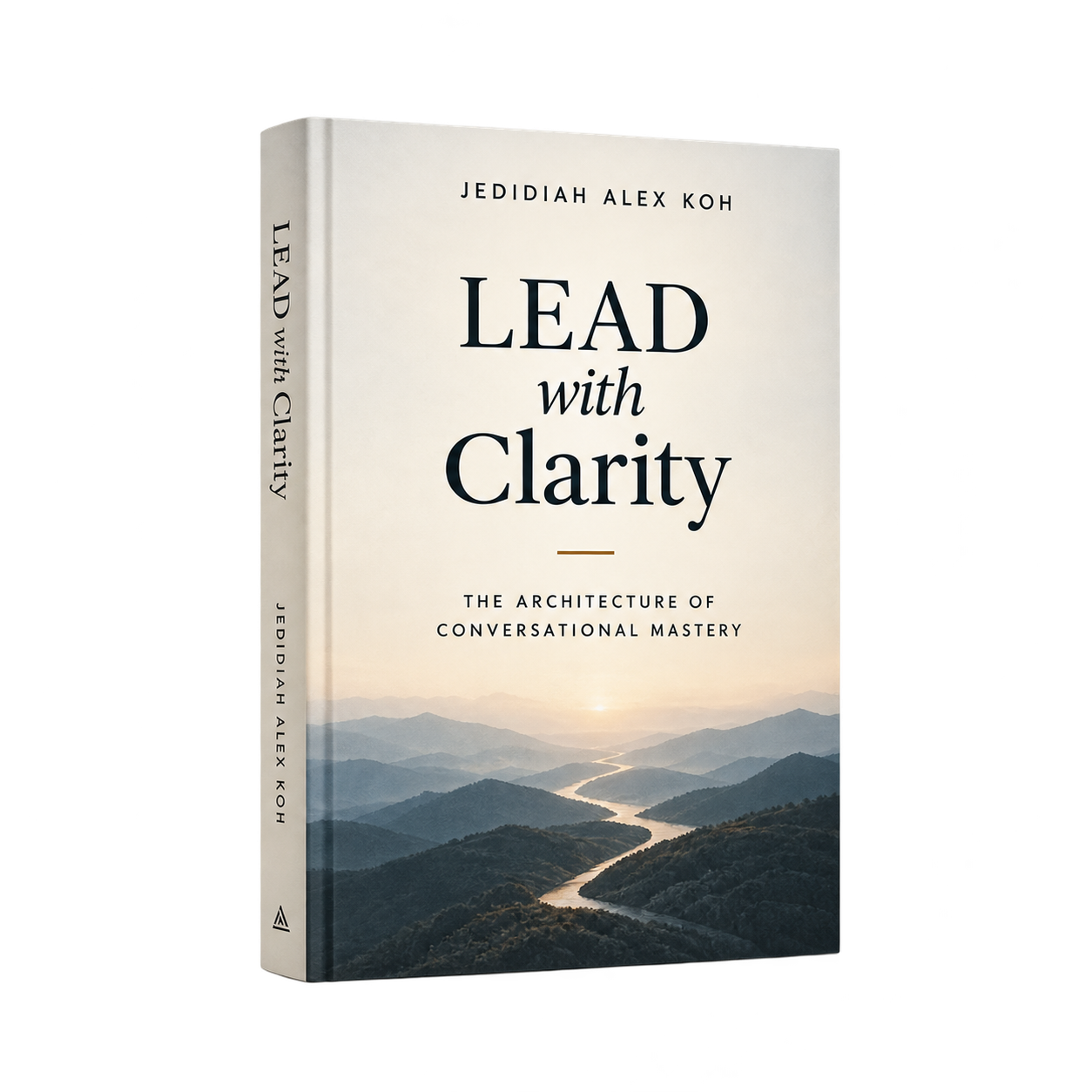
ABOUT THE BOOK
A practical guide to the LEAD Coaching Model, its five phases and the developing coach, in thirty-four chapters.
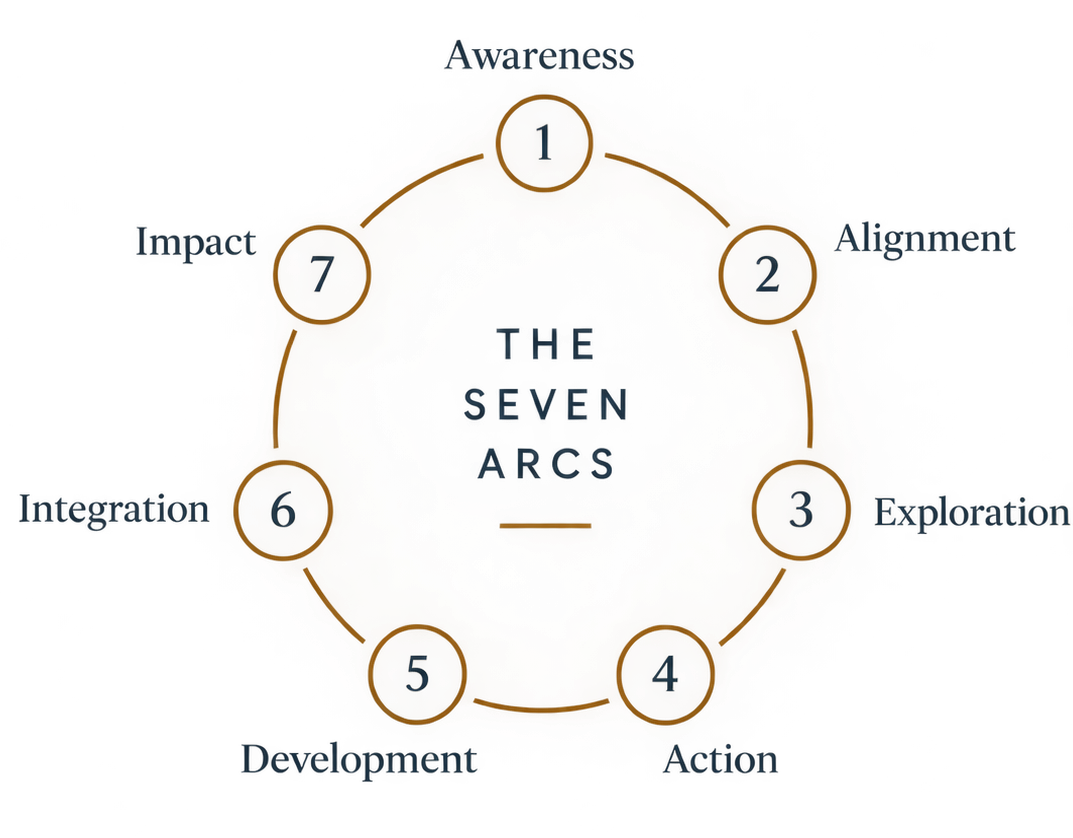
It is built as seven arcs rather than seven parts, and the word is deliberate. An arc traces a curve. Each one begins somewhere familiar and ends somewhere new, and the book returns to the same fundamentals at a deeper level each time rather than marching from problem to solution. You can read it straight through, and I recommend that the first time. After that, most practitioners return to one arc at a time, depending on what is alive in their work.
I wrote it for coaches who want the architecture in full, for coach educators who need a text their students can be assessed against, and for leaders willing to read a long book about a short thing: what happens in an hour between two people when one of them is trying to see.
Practical
Real examples, tools and reflections for everyday use.
Structured
A clear model, five phases, thirty-four chapters.
Focused
Built for coaches, leaders and curious minds.
Lasting
Thoughtful, applicable and meant to stay with you.
The Seven Arcs
of the LEAD Journey
The LEAD Coaching Model unfolds in seven arcs, each with a distinct focus. Together, they form a complete journey - from self-awareness to lasting impact, for both coach and coachee.
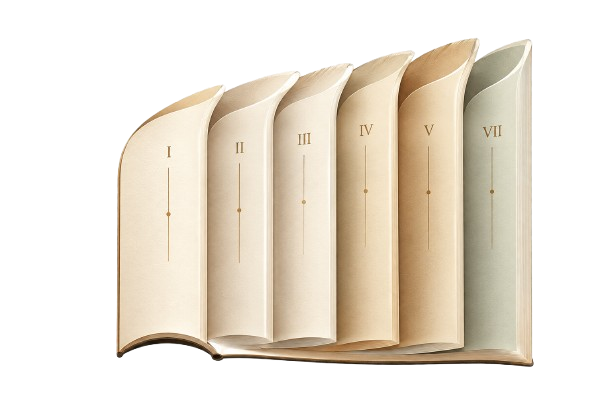
The shape of the book. LEAD with Clarity, first edition, thirty-four chapters and four appendices.
Thirty-four chapters sit across seven arcs, and they are not evenly distributed. The first three arcs, twelve chapters, are about perception, discernment and philosophy, and none of them teaches the model. Arc IV, three chapters, turns the lens onto the practitioner. Arc V is the technical heart: seven chapters, one for each of the five phases plus the two that open and close them. Arc VI, five chapters, is about what happens after the conversation ends. Arc VII, seven chapters, is the creative frontier, and it is the longest arc in the book after the technical heart. Four appendices follow as the practitioner's reference.
Key themes, arc by arc
Each arc explores a different dimension of the LEAD journey, with its own focus, questions and invitations.
The Weight Beneath Words
The gravitational nature of conversation • Emotional residue and psychological sediment • The persistence of the unfinished • What conversations carry beyond words • The mask of knowing and the weight of pretense
Escaping the Comfort of Models
The seduction of models and methods • Tool-dependence as developmental limitation • The emergence of discernment • Learning to read situations freshly • What lies beyond best practices • Holding frameworks lightly
The Philosophy of LEAD
Worlds within worlds • The ecology of human context • Courage as coaching competency • Co-creation versus expert delivery • The philosophical foundations of transformational practice • Entering another's world
The Inner Terrain of Mastery
Self as instrument • The calibration of presence • Shadow and projection in coaching • Ethical gravity and moral development • Sensory awareness and subtle perception • The developmental journey of the coach
The Architecture of the Conversation
Lead Outcomes as clarifying art • The courage of Examine • The expansion of Explore • The emergence of Evoke • Aligned Insights and identity integration • Decide and Act as embodiment • LEAD as living system
Beyond the Conversation Itself
The phenomenology of choice • The gravity of decision • When insight learns to walk • The spiral nature of change • Working with setback and return • The art of completion • Sustaining transformation beyond the session
The Creative Frontier
The creative frontier of coaching • Play as serious practice • Imagination as intervention • The wisdom of restraint • Ethics in the liminal space • Beyond technique to artistry • Emergence over force • The quiet future of clarity
All thirty-four chapters
Arc I · The Weight Beneath Words
- 1The Invisible Weight of Conversations
- 2When Words Move Nothing
- 3From Exchange to Meaning-Making
- 4The Burden of Always Having to Say Something
Arc II · Escaping the Comfort of Models
- 5When Frameworks Become Safe Havens
- 6The Myth of the "Best" Model
- 7Architecture vs. Formula
- 8LEAD as a Living Architecture
Arc III · The Philosophy of LEAD
- 9Worlds Within Worlds
- 10The Four Pillars of Brave Leading
- 11The Unseen Rhythm
- 12When Philosophy Becomes Flesh
Arc IV · The Inner Terrain of Mastery
- 13Presence as Practice
- 14Power, Safety, and Ethical Gravity
- 15The Art of Subtle Sensing
Arc V · The Architecture of the Conversation
- 16The Instrument Meets the Architecture
- 17Lead Outcomes
- 18Examine
- 19Explore and Evoke
- 20Aligned Insights
- 21Decide and Act
- 22LEAD as a Living System
Arc VI · Beyond the Conversation Itself
- 23The Gravity of Choice
- 24When Insight Learns to Walk
- 25The Architecture of Support
- 26The Rhythm of Return
- 27The Art of Completion
Arc VII · The Creative Frontier
- 28The Spiral of Mastery
- 29The Architecture of Experience
- 30Mizu Coaching: The Way of Water
- 31The Creative Frontier
- 32Brave Your Story
- 33Coaching in Practice
- 34The conversation continues

Where to find each phase
| Phase | Chapter | What the Chapter Does | In the Appendices |
|---|---|---|---|
| L · Lead Outcomes | 17 | The clarifying art: what this conversation is for, and the five movements by which an outcome is found rather than assumed | Appendix A, Phase 1 |
| E · Examine | 18 | The courage of examination: surfacing the present reality as it is rather than as it has been narrated | Appendix A, Phase 2 |
| E · Explore and Evoke | 19 | The expansion and the emergence, treated as two movements sharing one letter | Appendix A, Phase 3 |
| A · Aligned Insights | 20 | Insight and identity integration: the harvest, and how it is held so that it survives the week | Appendix A, Phase 4 |
| D · Decide and Act | 21 | Embodiment: commitment, design and the client's sovereignty over both | Appendix A, Phase 5 |
An Excerpt
From chapter one, The Invisible Weight of Conversations:
There is a conversation you cannot forget. You may not remember the precise words; language has a way of dissolving into impression, the way watercolour bleeds beyond its original strokes. The date has likely receded into the undifferentiated past. Perhaps you could not name the person who spoke with certainty, their face now more archetype than photograph in your memory. But the conversation itself, its timbre, its gravitational pull, what it did to you, remains. It altered the architecture of something internal. Shifted the ground beneath your feet in a way that left you standing somewhere irrevocably new.
Maybe it was a moment of recognition: someone saw you in a way you had not been seen before, their words functioning like a developer solution in a darkroom, bringing into visibility an image of yourself that had always been latent but never quite manifest. Or perhaps it was rupture: words that landed wrong, that opened a fissure which could not easily be sealed. It might have been quiet. The most consequential conversations often possess a strange pianissimo quality.

Lines from the book
Chapter 1, The Invisible Weight of Conversations
The most dangerous conversations are not the ones that hurt, but the ones that change nothing. We speak, we listen, we nod, we leave, and no one has been moved.
Chapter 2, When Words Move Nothing
Meaning is not discovered; it is made. And it is made together, or not at all.
Chapter 3, From Exchange to Meaning-Making
The master of conversation is not the one who always speaks but the one who knows when not to.
Chapter 4, The Burden of Always Having to Say Something
The model is not the territory, but when the territory frightens us, how tempting it is to retreat to the map.
Chapter 5, When Frameworks Become Safe Havens
The question is not which key fits all doors, but how we learn to meet each door as if for the first time.
Chapter 6, The Myth of the "Best" Model
LEAD is not a model to be executed. It is a way of inhabiting conversation that honours the irreducible complexity of our time.
Chapter 8, LEAD as a Living Architecture
Presence is not a trait you either possess or lack. It is a practice you either cultivate or neglect.
Chapter 13, Presence as Practice
Of all that matters, what matters most right now? That question, simple to ask and profound to answer, is where every genuine coaching conversation begins.
Chapter 17, Lead Outcomes
Exploration opens the mind; evocation awakens the heart. Together, they transform what is seen into what could be
Chapter 19, Explore and Evoke
The weight you feel before choosing is not weakness. It is the measure of how much you care about getting it
Chapter 23, The Gravity of Choice
The measure of coaching is not what happens in the room but what happens after we leave it. Every ending is a beginning in disguise, the moment when the client discovers they have become their own coach.
The four pillars of brave leading
Chapter ten argues that perceiving another person's world is not enough, and that the courage the work asks for is not the warrior's and not the rescuer's.It is quieter and more sustained, and the chapter names four forms of it.
The courage to enter.
To cross the threshold into another person's world rather than observing it from the edge, which is the safer and more comfortable place from which to be wise and useless.
The courage to stay.
To remain when the conversation becomes uncomfortable, when nothing is resolving, and when leaving would be easily justified as respect for the client's pace.
The book maps these loosely onto the model, entering at the beginning of engagement, staying through examination, naming as insight emerges and releasing at the end. It then says that the mapping should be held lightly, because in practice all four may be needed in a single minute, and that a coach who enters but cannot stay never reaches the depth where anything changes.
The five infinite fundamentals

The five infinite fundamentals. LEAD with Clarity, chapter 28, The Spiral of Mastery. Jedidiah Alex Koh.
Chapter twenty-eight argues that there are no advanced techniques. There are only fundamentals, practiced deeply enough that they stop being things a coach does and become what a coach is. It names five, and calls them infinite because none of them has a ceiling.
Observation is seeing what is actually present, rather than what we expect or prefer. Listening begins with content, deepens to emotion and pattern, and ends at what the person is not saying. Presence, the chapter says, is allowed rather than done, because trying to be present adds the effort that interferes with it. Spaciousness is the quality of not filling: the pause left alone, the silence left unrescued. Honor is the fifth, and it is the one least discussed in Western coaching writing.
Honor comes from Japan. The chapter takes it from the tea ceremony, where how you enter a room and how you hold a cup are not casual, because nothing there is merely functional. It takes it also from the Japanese garden, where the relationship between the stones is considered and the empty space is as deliberate as what fills it. Then it asks what that would mean inside a coaching hour. Every question placed with intention. Every silence honored. The person across from you treated as someone worth preparing for, rather than a problem arriving with a calendar invitation.
The practitioner's reference
The last quarter of the book is reference material, built to be returned to rather than read once. There are four appendices.
| Appendix | What it is | Who uses it |
|---|---|---|
| A The Five Phases of LEAD: A Comprehensive Practitioner's Guide | Each phase in full: its intention, what to observe and listen for, how to craft questions that serve rather than direct, and how the phase supports the client's own movement. The longest of the four. | Practitioners working on one phase at a time, and educators teaching a phase in a single session |
| B The Axioms of LEAD: Principles for a Life of Transformational Practice | Ten axioms written for the moment when technique falls away: principles to be inhabited rather than rules applied. They appear in full on the model's own page. → /lead-coaching-model | Anyone past the stage of needing steps |
| C The Practice of LEAD Through the ICF Core Competencies | The model mapped against the competency framework, for practitioners preparing for assessment and educators who have to show where a competency is taught. The book's position is that the competencies are a mirror rather than a map. | ACC, PCC and MCC candidates; mentor coaches; accredited programme directors |
| D The Practice of Reflection: The 5 I's Framework for Coaching Mastery | Reflective practice in five movements: Intention, Intentional, Incremental, Immerse, Infinitesimal. The book attributes it in place to Jedidiah Alex Koh and frames it as an answer to the coach who accumulates hours without accumulating wisdom. | Learners on the programmes, and any coach whose reflection has become a habit of remembering rather than a practice |
Who it is for
Coaches who want the whole architecture, not a summary of it.
Coach educators who need a text their students can be assessed against.
Leaders who are willing to read a long book about a short thing.

Four ways to read it
Straight through, the first time. The arcs are built to deepen, and each one lays ground the next stands on. This is the author's own recommendation, and it is the route for anyone entering professional coaching.
01
Then by what is alive in your work. A practitioner working on presence returns to Arc IV. One whose clients keep not doing the thing returns to Arc VI. One whose range has narrowed goes to Arc VII.
02
By phase, as a reference. Chapter and appendix section for each of the five are in the table above, and the two can be read as a pair.
03
Actively, whichever route you take. The book asks you to pause, to try the ideas with actual clients, and, in its own words, to notice what resonates and what resists. Its argument is that transformation is not transmitted through text.
04
The LEAD with Clarity Series
| Volume | Title | What it covers |
|---|---|---|
| I | LEAD with Clarity You are here | The full architecture, the philosophy beneath it and the developing practitioner. |
| II | LEAD Where You Stand | The coaching conversation playbook for the leader you are becoming. The accessible entry point. |
| III | LEAD in Command | Coaching conversations for military leaders who shape what comes next. |
| IV | LEAD Where It Counts — in preparation | Title and scope to be confirmed. |
| V | LEAD Together | Coaching the team as a living system. |
| VI | LEAD Across Systems | Leading across complexity, boundaries and interdependence. |