
IDEAS > PUTURE
PUTURE and the Axis of Possibilities™
PUTURE is a coaching model for exploring time, motivation, and identity beyond a single linear view of the future. It helps people move from projecting what is known to sensing what could be—especially when traditional plans no longer make sense.
The future is useful when life behaves like a line. PUTURE begins when it no longer does.
Why PUTURE™ exists
The future, as we usually use the word, is a line. We project it forward from what we know, plan along it and measure ourselves against it. That works for situations that behave like lines. It becomes less useful when a career has stopped making sense, a decision has no good option, or a person cannot yet say what they want because their wanting has had no room.
I coined PUTURE after noticing a recurring shift in coaching conversations across Singapore, Taiwan and Japan. Someone would arrive trying to choose a gap between the trees. Then the conversation would widen, and they would begin to see the whole terrain. I needed a word for that field.
“The future is useful when life behaves like a line. PUTURE
begins when it no longer does.”

How the PUTURE Axis of Possibilities works
The PUTURE Axis is a three-dimensional orientation system built around the person. It locates a conversation on three axes at once.
The time axis asks how the person is relating to the past, the present and PUTURE.
The motivation axis asks whether Protection or Pursuit carries more weight in this moment.
The identity axis asks about the distance between private personhood and public persona.
The person stands at the centre, in the present. Beneath the axes is Preponderance, my term for the unseen weighting that makes one direction feel heavier than another. The model does not decide for the person. It helps the conversation notice where they are and what is shaping the tilt.
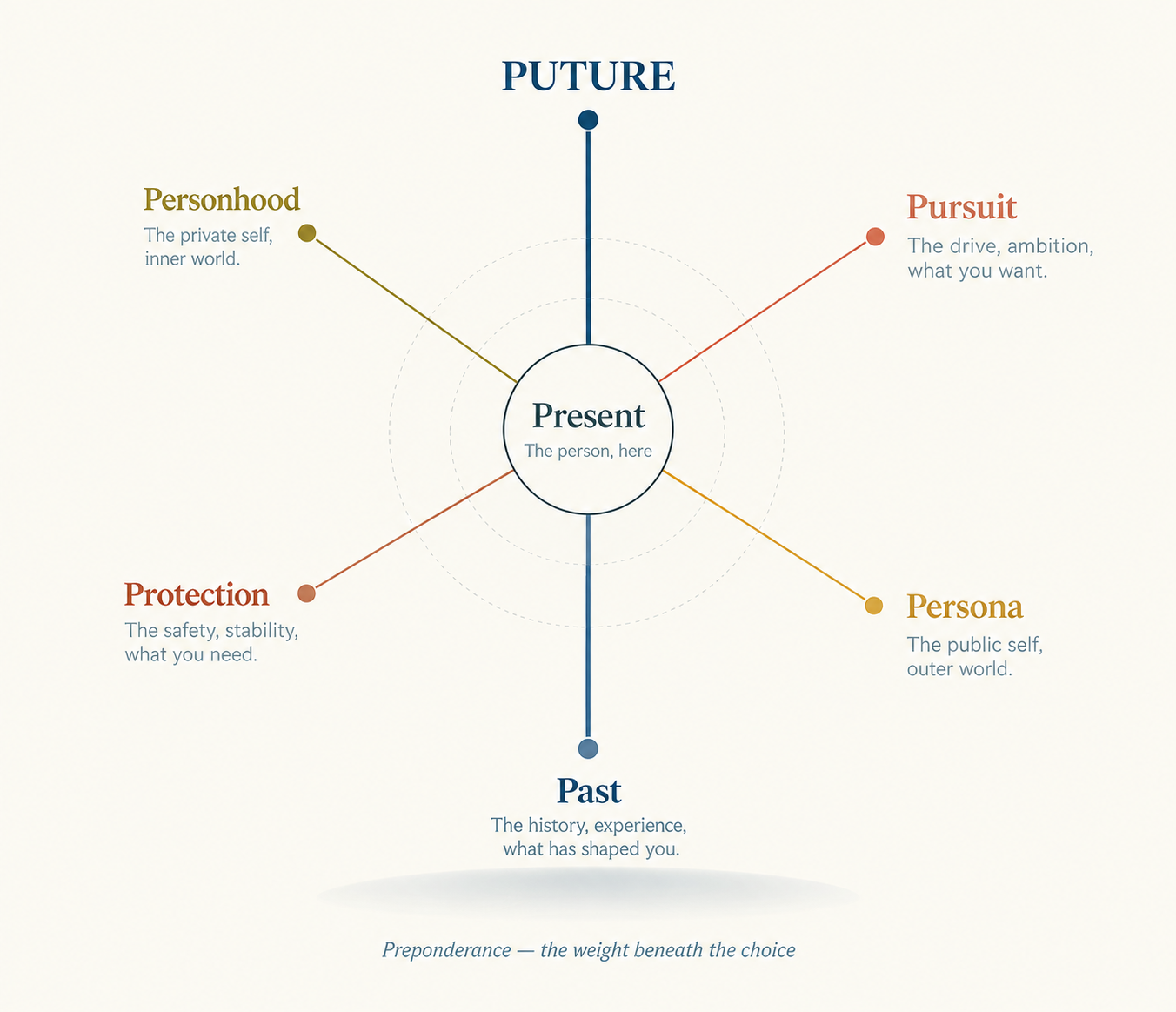
The Three Axes and the Centre
Locating where a conversation actually is not its topic, but the position it's spoken from.
The time axis, from past to future
The past can teach without becoming a prison. The present is the ground beneath the conversation. The future is what hasn't yet been filled with plans or expectations.
Most people are anchored in one position without noticing. The coaching move is to spot the anchor and ask if it still serves.
Sample question
If the next chapter were not already written, what would you be curious about?
The motivation axis, from protection to pursuit
Protection guards what's been built. Pursuit reaches toward growth and meaning. Both carry intelligence; neither is the default problem.
"I should stay, but I want to go" says the whole axis in one line. The task isn't to make Pursuit win — it's to weigh what each side knows and costs.
Sample question
What are you protecting, and what are you pursuing?
The identity axis, from personhood to persona
Personhood is the private self. Persona is the self performed in public. Moving between them is usually social intelligence, not dishonesty.
It becomes a concern only when the gap grows too wide to find oneself inside the performance — or too narrow to have any privacy left.
Sample question
What can you say here that your role does not usually allow you to say?
Protection is not resistance to be defeated. Sometimes it is the wisest part of the person in the room.
The centre: personhood, potentiality and paradox
At the centre is the person, not the problem. Potentiality holds what's alive but unnamed. Paradox lets more than one truth stay present without forcing early resolution.
It's where the axes meet — not a neutral point, but a call to stay in contact with the whole person choosing.
Preponderance, and the weight beneath a decision
From the Latin praeponderare, to outweigh — a metaphor for the invisible weighting beneath a choice. History, duty, fear, loyalty and loss can make one position feel heavier before a person has consciously decided.
The axes show where the conversation is; Preponderance explains why it keeps returning there. It draws on Kahneman and Tversky's work on decisions under uncertainty.
Principles of PUTURE
PUTURE principles offer a flexible and deeper way of seeing the future in coaching and teaching.
The Axis becomes most useful when it is held as a way of seeing rather than a test. These principles describe how I use it in coaching and teaching. They are not steps, and a conversation may return to any of them more than once.
Keep the person larger than the problem
A problem can grow so dominant the person appears only as the one who has it. The future keeps the person at the centre. The question isn't just how to remove the difficulty — it's what this person is noticing, protecting, becoming and able to choose now.
Let possibility arrive before commitment
Possibility is not a promise. A person can consider a direction without defending, funding or choosing it right away. That temporary freedom lets desire, fear and alternatives become speakable before practical judgement begins.
Listen to Protection before asking it to move
Protection often carries facts the rest of the conversation is tempted to dismiss: a duty, dependency, risk, loss or memory of harm. Listening to it isn't obeying it — it's understanding what any responsible possibility must account for.
Allow personhood and persona to inform each other
Persona helps us meet roles and relationships; personhood carries quieter experience. The aim isn't to strip away persona or force disclosure — it's to notice whether the public role still leaves room for private truth.
Stay with paradox long enough to learn
Some choices hold two legitimate truths. Moving too quickly to resolve them can hide the real choice. Paradox creates enough time for both truths to speak, while urgency, safety and consequence stay visible.
Judge a possibility by whether it can be inhabited
A possibility is useful when the person can live inside it without abandoning safety, responsibility or self-recognition. The most exciting option isn't necessarily the most viable one — a quieter option may create more honest movement.
Return choice to the present
The past brings learning and the future brings range, but choice still happens in the present. A conversation should return to the person who is here now, with the information, limits and agency available now.
What PUTURE is not
Not a misspelling
PUTURE is a coined word formed from Possibilities and Future. It names a field of possible futures rather than a single line projected from what is already known.
Not positive thinking
The model does not ask someone to imagine a brighter outcome and ignore difficulty. Protection matters as much as Pursuit, and paradox remains at the centre. The field includes the possibilities a person would rather not see.
Not futures thinking or scenario planning
Futures thinking and scenario planning examine multiple futures for organizations or systems. PUTURE is used around one person in a conversation. Its unit is a life, not an institution.
Not a personality type
Nobody is a Protection type or a Persona type. The axes describe where a person is in this conversation. Their position may change as the conversation changes.
-A WORKED EXAMPLE
A decision that looked binary
A leader arrives with a promotion decision. The organization needs an answer by Friday. On the surface, the choice is binary: accept the role or decline it. They have already made a list of advantages and disadvantages, but the list has only made the decision feel tighter.
The time axis
The time axis reveals that the leader is anchored in the past. The promotion has become proof that earlier sacrifices were worthwhile. Declining it feels less like refusing a job and more like rewriting the meaning of the last ten years. The present, including what the role would actually require now, has almost disappeared from view.
The motivation axis
The motivation axis appears in one sentence: ‘I should take it, but I do not want the life that comes with it.’ Protection is carrying loyalty, income and the wish not to disappoint people who invested in them. Pursuit is carrying a quieter aspiration: work with more depth, fewer performances and more room to think. Neither side is irrational. Both are trying to protect something meaningful.
The identity axis
The identity axis shows another gap. Publicly, the leader is known as ambitious and dependable. Privately, they are tired of proving that identity. They have been treating the public persona as a promise that the private person must keep. Once the two are named separately, declining the promotion no longer has to mean becoming less ambitious. Accepting it no longer has to mean keeping the role unchanged.

“The conversation did not produce a cleverer answer. It changed the shape of the decision.”
Where PUTURE applies and where it strains
PUTURE applies in coaching, leadership, mentoring and facilitation when someone is deciding under uncertainty and the single-line future has stopped helping. It is most useful when the person has enough time, safety and agency to examine how they are relating to the choice.
The axes also require cultural calibration. What counts as Protection in one setting may be understood as Pursuit in another. The distance between personhood and persona is shaped by culture, role and power. A useful question in Tokyo may need different language in New York, Singapore or Taipei.The model strains when a decision is urgent and widening the field becomes a way to avoid acting. It also strains when obligations remove any real freedom to move,

“A possibility is useful only when the person can inhabit it without leaving themselves behind.”
Origin and evidence
I first wrote about PUTURE in a Forbes Coaches Council article in August 2020 and spoke about it in a video series that year. The full model, PUTURE: The Axis of Possibilities, was published in March 2026 with the P-Lexicon, a listening and question bank, an annotated transcript and application guides.
The model inherits established work on temporal perspective, approach and avoidance, and the relationship between the private and presented self. It brings those lines of thought together around one person and adds Preponderance as a practical way to notice the weight beneath a decision. The book contains the full intellectual lineage and bibliography.
What evidence exists
The current record consists of the book and its worked material, six years of use in coaching rooms and workshops, and the dated 2020 article and video series. These establish authorship, development and practice.
What evidence does not yet exist
The PUTURE Axis has not yet been independently studied or validated as a model. It draws on established research, but that is different from having direct research behind the model itself.
What would strengthen the evidence
Useful next steps would include a study of coaching conversations coded by axis and outcome, and independent validation of the self-assessment scales published in the book.
Go deeper in the book
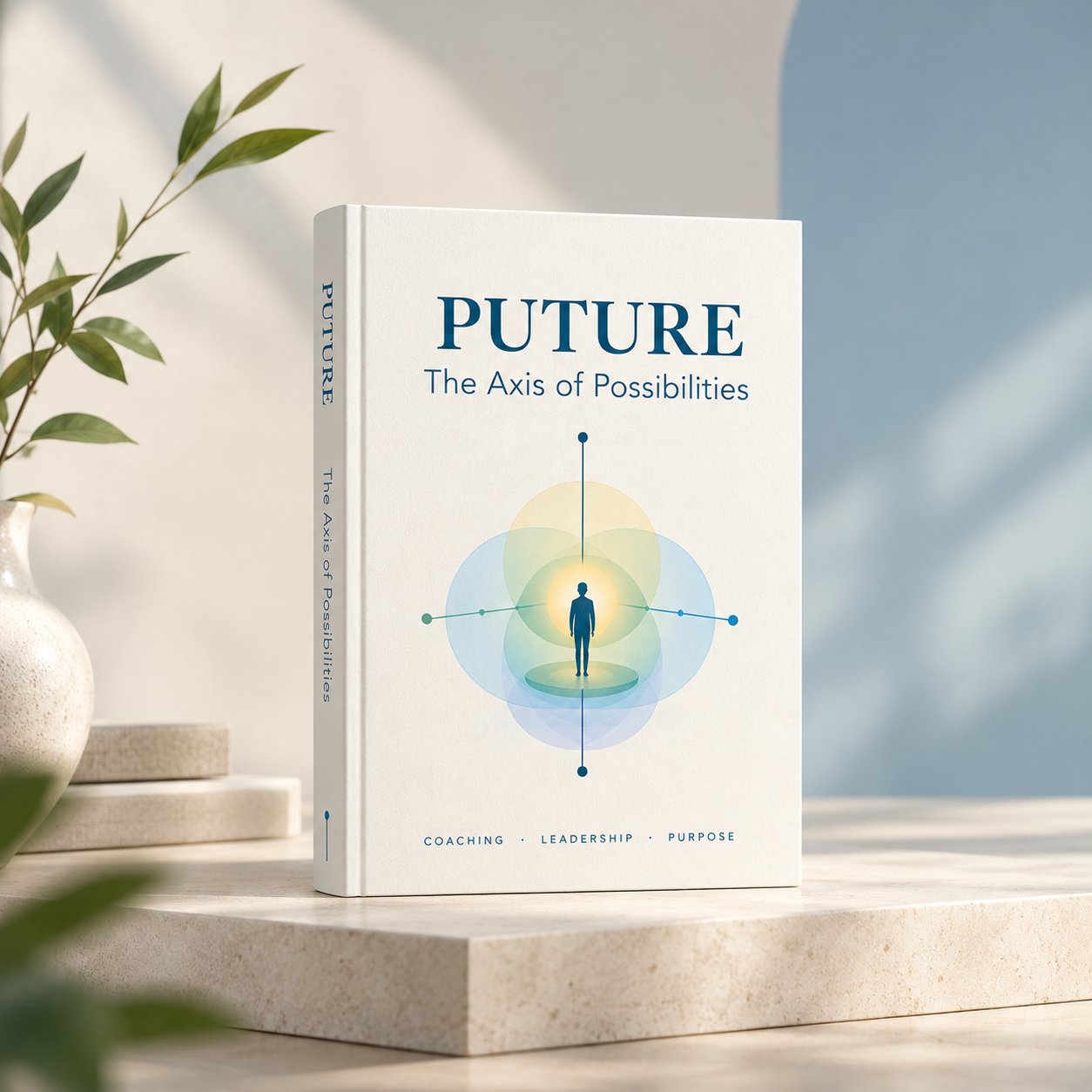
This page introduces PUTURE and offers a working map of the Axis. The book develops the model in full, including the P-Lexicon, a listening and question bank, an annotated coaching transcript, self-assessment scales and application guides for practice.
If you want to study the model or use it more deliberately in coaching, leadership, mentoring or facilitation, continue with PUTURE The Axis of Possibilities.

How to cite this page
Koh, J. A. (2026). PUTURE and the Axis of Possibilities (version 1.2). Brave Your Story→

References
1. Koh, J. A. (2026). PUTURE: The Axis of Possibilities: A New Way of Seeing for Coaches, Leaders, and the People They Serve. Brave Your Story.
2. Koh, J. A. (2020). Puture: Encouraging Organizations' Nonlinear Growth by Envisioning Future Possibilities. Forbes Coaches Council, 7 August 2020.
About Jedidiah Alex Koh→