

The LEAD Coaching Model
By Jedidiah Alex Koh . Version 3.0 . First published 2018 . Revised 2024 . The leader's conversation
Definition
The LEAD Coaching Model is a five-phase architecture for coaching conversations, developed by Jedidiah Alex Koh, in which a conversation moves through Lead Outcomes, Examine, Explore and Evoke, Aligned Insights, and Decide and Act: five phases carried by four letters, because the second E holds two movements.
For leaders who coach and coaches who lead, and for the educators who develop them.
A conversation that ends in a learning the person can say in one sentence, and an action they designed themselves.
It is an architecture the conversation moves through, recursively, not a script the coach follows.
Why Lead
Most coaching conversations that go wrong do not go wrong at the level of the question. They go wrong at the level of shape. The conversation circles because nobody said what it was for. It examines the situation and then keeps examining, because the coach mistakes understanding for progress. Or it rushes to action, and the action comes from the coach's mind rather than the client's. I watched this for years, first in my own conversations and then in hundreds of recordings as a mentor coach and assessor, and the pattern was the same in Singapore, in Taipei, in Tokyo: the questions were often fine, and the shape was missing.
LEAD began in 2018 as the shape I was already using, written down so that the people I trained could see it. It has been revised through five books, three accredited curricula and partner deliveries in Chinese and Japanese, and its current form is the one on this page. The name is an acronym, and the acronym is deliberately imperfect: four letters carry five phases, and the reason is in the third section below.

The framework
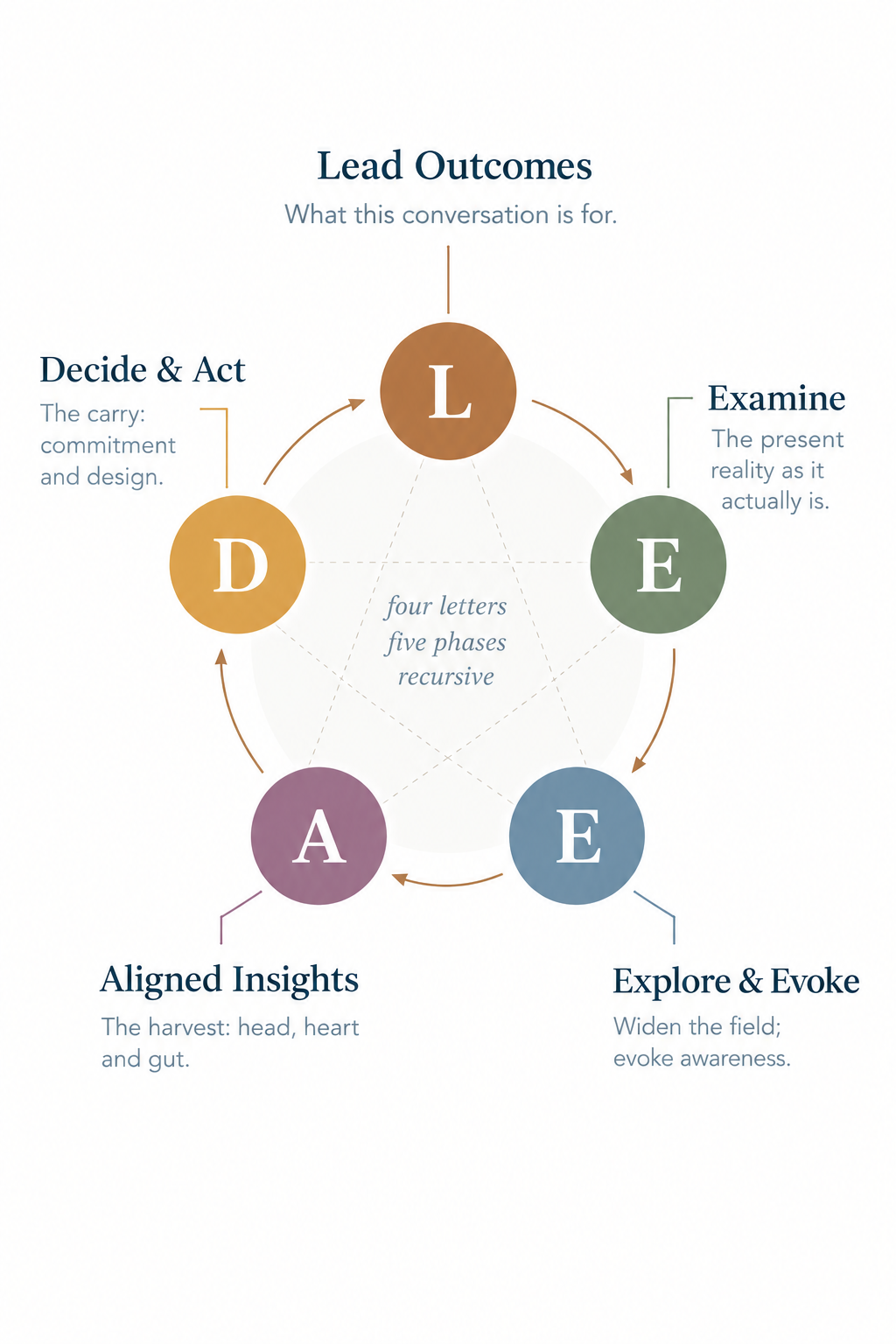
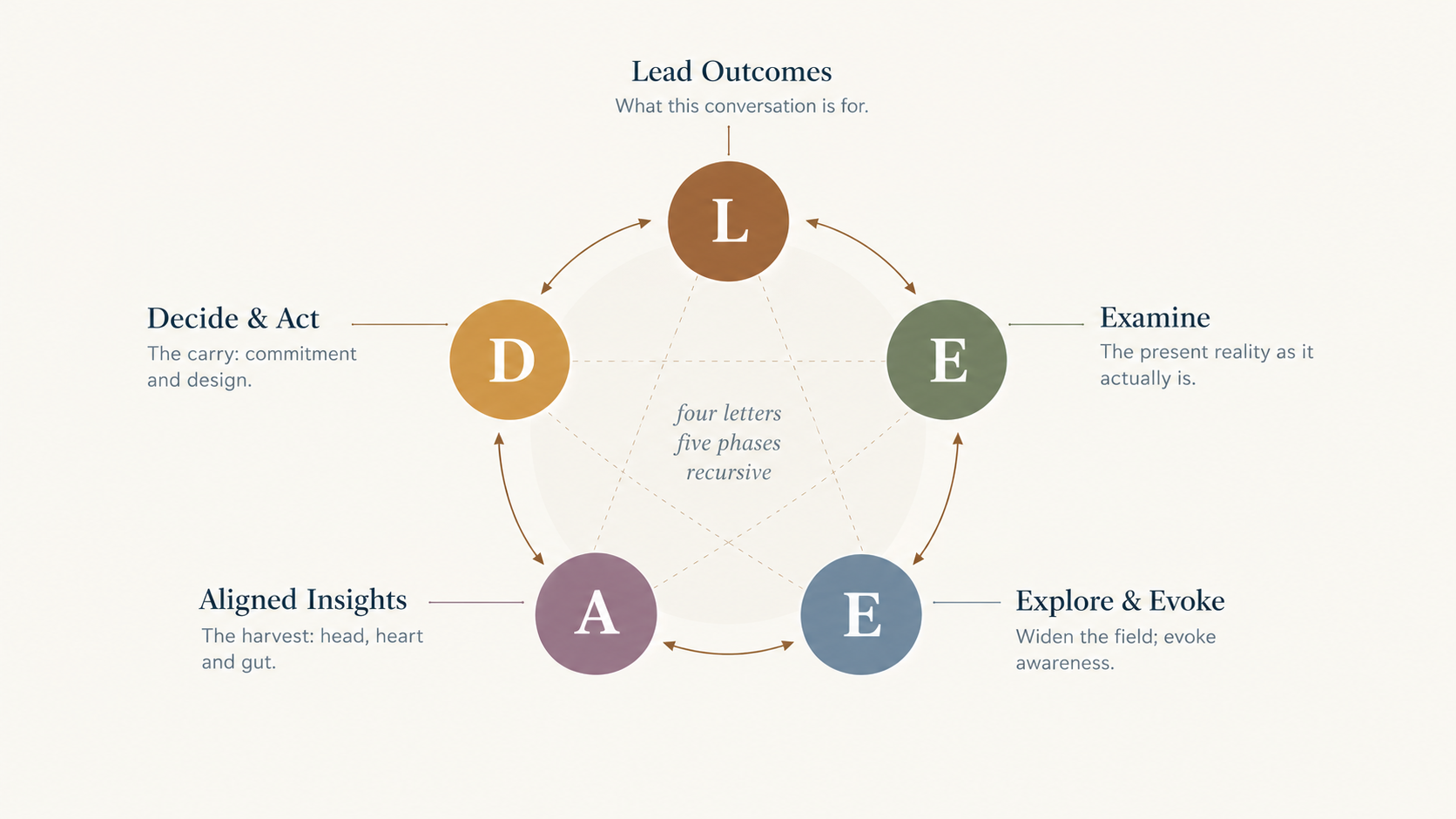
The diagram shows five phases arranged as a loop rather than a line. Lead Outcomes sits first: what this conversation is for. Examine follows: the present reality as it actually is. Explore and Evoke widens the field and evokes awareness the person did not arrive with. It shares the letter E with Examine, which is why the model reads as four letters and five phases. Aligned Insights is the harvest, where insight is integrated so that it holds in head, heart and gut. Decide and Act converts insight into commitment and design. Arrows return from every phase to every other, because the phases are recursive, not sequential: a conversation may return to any phase at any time, and the skill of the coach is knowing which phase the conversation is actually in.
The five phases of LEAD™
Lead Outcomes
Naming what the hour is for — not the topic, but the outcome. The Five Essential Movements carry it, ending in an agreement no one in the room has to fake.
Examine
Surfacing present reality as it actually is, not as it's been narrated. The Ground Truth Scan and 4-Layer Inquiry pull fact and interpretation apart.
Explore and Evoke
Explore widens the field; Evoke calls up what the person already knew and hadn't said. Carried by Two-Lens, the 3-Axis Lens, Metaphoric Bridge and Scaling Inquiry.
Aligned Insights
The harvest: everything up to one high-resolution sentence the person can say for themselves. Layers of Learning makes it hold in head, heart and gut.
Decide and Act
The carry: insight converted into a commitment sized so it can't fail. GO 6 Steps and ANCHOR build it; VIBEE holds the conditions that make it stick.
What holds the phases together: five laws
The five laws of LEAD™
The phases say where a conversation is. They do not say why the model works. Beneath the architecture sit five laws, written out in LEAD with Clarity, and they are the reason two coaches who have never met can use the same five phases and produce conversations that sound nothing alike. They are patterns to recognize, not rules to enforce.
The Law of the Keystone
In every conversation, one outcome holds the others in position
People arrive with many wants and many problems. The temptation is to serve them all, and attention spread across everything lands on nothing. The work of Lead Outcomes is to find the one outcome that, once named, holds the rest in place.
The Law of Co-Creation
Leadership is no longer directive but generative.
Neither the coach nor the person holds all the wisdom, and neither the leader nor the team holds all the answers. What matters is what can be created together. This is the stance the whole model assumes, and it is the reason the model refuses the expert posture in every phase.
Insight cannot be compelled; it can only be invited.
Insight cannot be compelled; it can only be invited.
The coach does not produce the person's insight. The coach creates the conditions in which something new can appear, and then has the discipline to wait for it. This is why Explore and Evoke is two movements and not one: widening the field is preparation; evocation is what emerges.
The Law of Recursive Depth
The path is not linear but cyclical.
Reaching Aligned Insights does not mean the examining and exploring are finished. A new insight can reveal that the reality has shifted, and an action can send the conversation back to exploration. The architecture is not a ladder to ascend but a landscape to navigate, which is why the diagram above is a loop.
The Law of Short Cycles
Decide and act in rapid iterations:
modest movements, continuous adjustment. In complex situations, waiting for perfect clarity before acting guarantees paralysis. A small step, observed, teaches more than a large plan. This is the law that makes Decide and Act a design problem rather than a commitment ceremony, and it is the law that Short-Cycle LEAD is built on.
The ten axioms of LEAD™
The ten axioms
I. Every conversation is a learning moment, for both coach and client. The coach who stops learning has stopped truly coaching.
II. Insight without alignment is noise. Awareness, by itself, transforms nothing.
III. Coaching changes lives. We must be careful not to domesticate what we do.
IV. Growth happens at the edge of awareness and responsibility. The coach's role is not to make this discomfort disappear but to make it productive.
V. Coaching is not what you do, but how you show up. The instrument matters less than the musician.
VI. Courage is the prerequisite of all coaching virtues. They notice but do not name. They sense but do not say.
VII. The stories within us shape the stories we can hear. We do not coach from a neutral position.
VIII. Mastery is continuous refinement, not final arrival.
IX. We do not transform people. We create conditions for transformation.
X. The goal is always to make ourselves unnecessary.
The laws describe the model. The axioms describe the practitioner. LEAD with Clarity closes with ten of them, written for the moment when technique falls away and what remains is what a transformational conversation actually asks of the person holding it. They are printed here in full as titles, because the titles are the axioms. The book carries the argument and the stories beneath each one.
What it is not
It is not a four-phase model. LEAD has five phases. Some earlier materials, including passages in print, describe four movements or use Listen as the first phase; those forms are superseded, and this page is the reference. Four letters carry five phases, and the second E holds two.
It is not GROW's sequence with new labels. GROW, developed by Graham Alexander, Alan Fine and John Whitmore, moves from Goal to Reality to Options to Will. LEAD shares its ancestry and departs from it in two places: it separates the harvest of insight (Aligned Insights) from the design of action (Decide and Act), because in practice they are different work, and it treats the phases as recursive rather than as an order to complete.
It is not a script. The phases name what a conversation is doing, not what the coach must say next. Two coaches using LEAD well will sound nothing alike. The skill the model asks for is diagnostic: knowing which phase the conversation is actually in, and whether it needs to move.
It is not only for formal coaching sessions. A complete cycle can take an hour or five minutes. Short-Cycle LEAD, described in LEAD Where You Stand and LEAD in Command, is the same five phases compressed for the corridor conversation, which is where most leadership actually happens.
It is not a coaching-culture or change-management framework. LEAD is an architecture for a conversation. It is used at every level of an organization, and the section below says how, but its unit is always the conversation between people, not the organization. Other frameworks share the four letters, including one published for auditing an organization's coaching culture; they share the acronym and nothing else, and this page is not about them.
A worked example
A regional head in Singapore, three months into a bigger job, opens with the topic: a direct report who is "not stepping up." Lead Outcomes takes longer than she expects. The outcome she first names is "decide whether to move him." The outcome she settles on, after the coach asks what would be different for her at the end of the hour, is "know what I actually want from him, so that whatever I decide is fair."
Examine slows the story. What has she seen? Two missed deadlines and a meeting where he said little. What has she concluded? That he is disengaged. The coach separates the two, and she notices that one of the deadlines was hers.
Explore and Evoke widens the field: what would his version of the last three months sound like? She laughs, then goes quiet. Then the evocation: "Say the thing you have not said." She says that she has not told him what the new job needs from him, because she is not sure herself.
Aligned Insights harvests it in one sentence, hers: "I have been assessing him against a job I have not yet described." It holds; you can hear it in her voice.
Decide and Act is short. The action is not a performance conversation. It is a forty-minute meeting in which she describes the job. She designs the accountability herself: she will send the coach the one sentence she used to open it.
The whole conversation took fifty minutes and moved through the phases twice.
One language across the organization
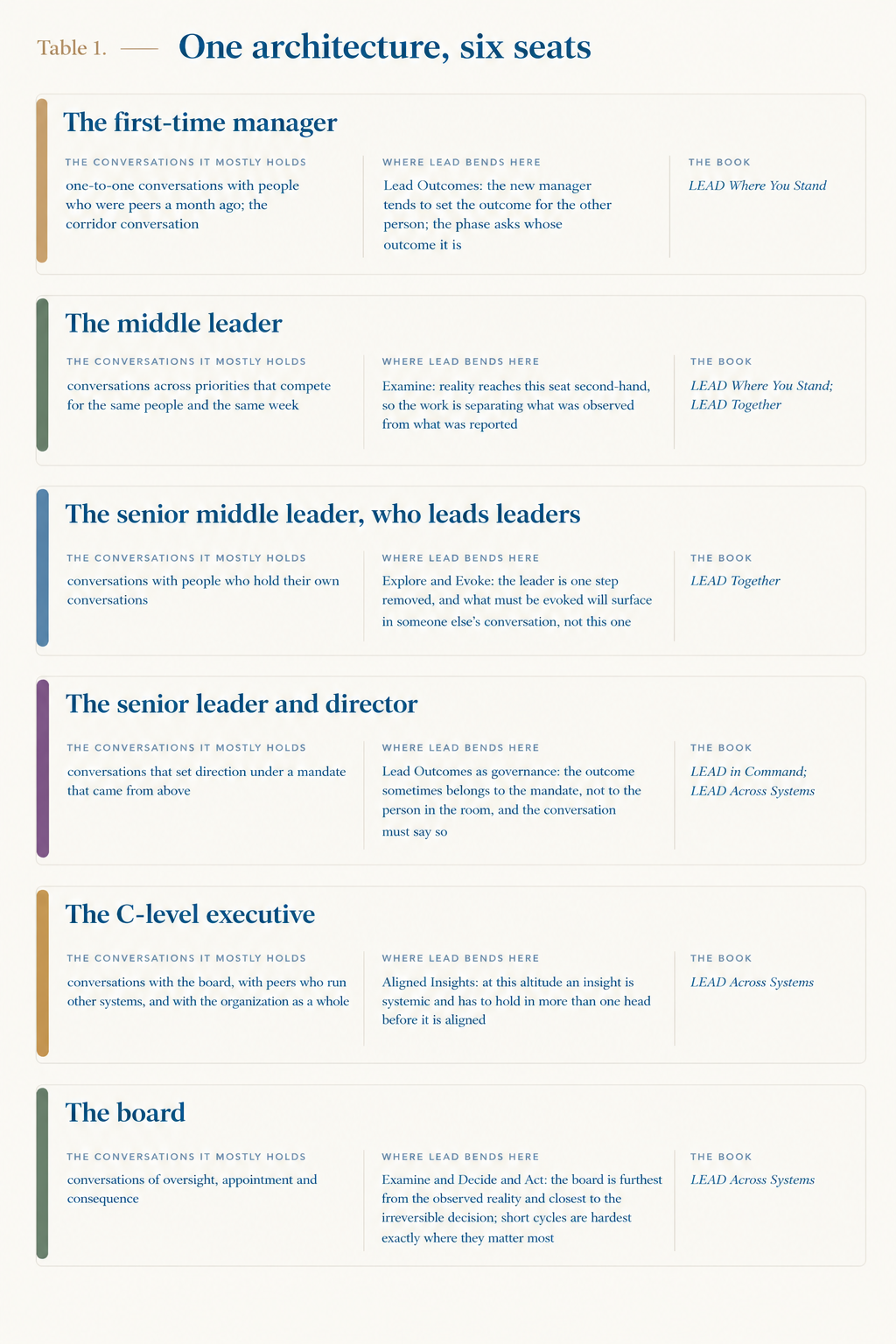
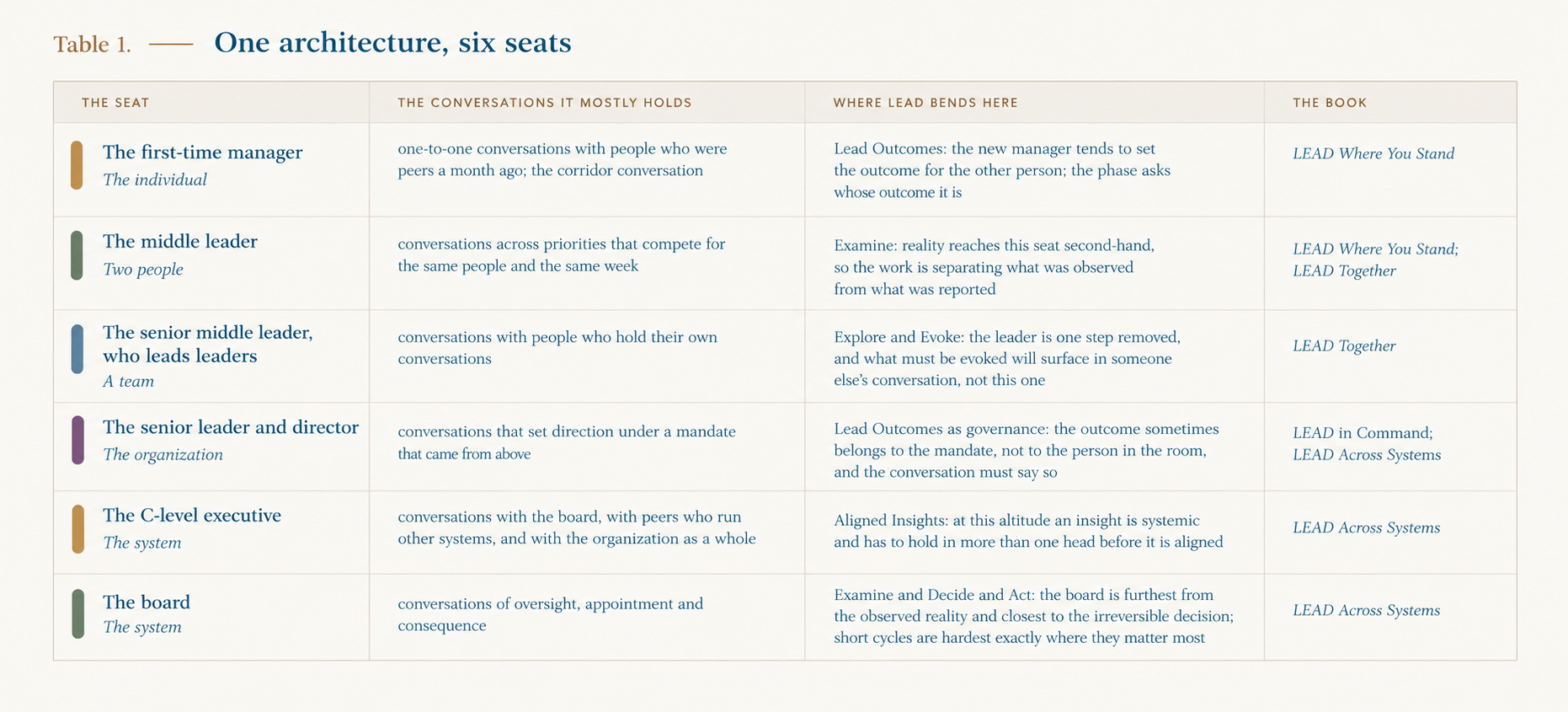
The model does not change from seat to seat. That is a rule I hold myself to: a first-time manager in my Level 1 class and a board chair I coach meet the same five phases, with the same names, in the same order, because the moment a model grows a variant for every context it stops meaning anything. What changes from seat to seat is the pressure the seat puts on the model: the place where the architecture bends, and what a practitioner does about it. Naming that pressure is how the same five phases stay honest at six altitudes.
That is also what "a common language" means here, and it is more useful than it sounds. When everyone in an organization can say which phase a conversation is in, a manager and her director can disagree about a decision and still agree that the conversation has not yet examined the reality; a board can ask an executive team what the lead outcome of a proposal is and be understood; a coach can be assessed by a mentor coach against the same architecture the leaders use. Depth comes from the shared architecture, not from a different model at each level.
Where it applies, and where it strains
Where It Applies
It applies wherever one person is responsible for developing another through conversation: managers and senior leaders with their teams, in the six seats described above; coaches in training toward a credential; public-sector and military leaders, for whom LEAD in Command was written; and coach educators who need a shared architecture their students can be assessed against.
Where It Strains
It strains in three places, and the strain is worth naming. When the outcome belongs to someone who is not in the room, Lead Outcomes cannot be completed honestly, and the model will not fix that. When the person is not free to decide, because the decision has been made above them, Decide and Act becomes theatre. And when a conversation is really a decision already taken and looking for cover, no architecture helps. The honest move is to say so.
Origin
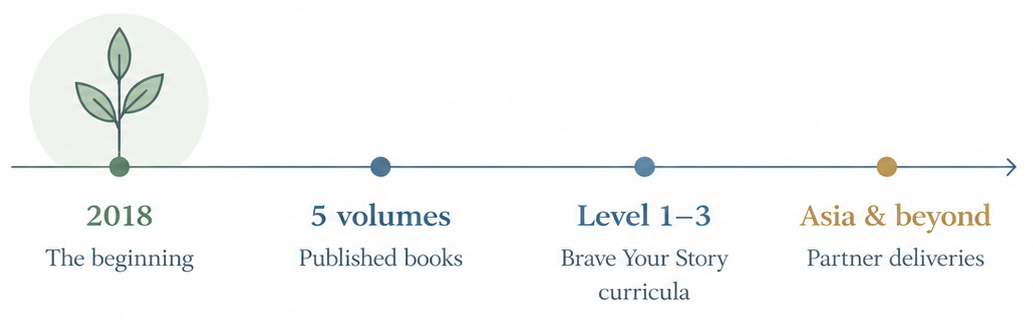
I began writing LEAD™ coaching model down in 2018, after years of using a shape I had not named, so that the coaches I was training could see the shape and be assessed against it. It has been revised through five volumes (LEAD with Clarity, LEAD Where You Stand, LEAD in Command, LEAD Together, LEAD Across Systems), through the Level 1, Level 2 and Level 3 curricula of Brave Your Story, and through partner deliveries across Asia and other regions.
Evidence
Five published volumes; three ICF-accredited curricula in which the model is the assessed architecture; delivery through partners in Taiwan and Japan; and the assessor's seat, from which I have listened to several hundred recorded conversations against the ICF standard, many of them structured on this model.
WHAT EXISTS
No independent study of the LEAD Coaching Model has been published. The claims on this page rest on practice, on the standard, and on the inheritance named above.
What does not exist yet
A study of consented recordings coding conversational moves by phase, with outcomes; a comparison against GROW-structured conversations on the same measures; or an independent replication of the phase structure by a coach educator who did not learn it from me. The research shelf will carry each of these as it exists, and will say so plainly if it does not.
What would count
Where it is taught
The LEAD Coaching Model is the architecture assessed in Brave Your Story's ICF-accredited Level 1, Level 2 and Level 3 programmes, and in the leadership programmes delivered to organizations.
Programmes →
Go further
LEAD with Clarity · LEAD Where You Stand · LEAD in Command · LEAD Together · LEAD Across Systems (each to its /books page)
Books that
teach it
Five Essential Movements · Ground Truth Scan · 4-Layer Inquiry · Two-Lens · 3-Axis Lens · Metaphoric Bridge · Scaling Inquiry · Layers of Learning · GO 6 Steps · ANCHOR · VIBEE · Coda Close · Short-Cycle LEAD (each to its anchor on /frameworks)
Techniques
within it
LEAD learner resources, for participants of the Level 1, Level 2 and Level 3 programmes; a password is issued in class → /learn/lead (omit until the page exists)
Papers
The LEAD Coaching Model, version 3.0: the white paper edition (PDF, with DOI) → /research (omit until the paper is published; see section 8, item 9)
For learners
on the programmes
(omit until the LEAD concept note is live on /research)
PRACTICSE IT
(omit until /learn pages exist)
RESEARCH
Recent Reflections
(omit until the LEAD concept note is live on /research)
About the author
Jedidiah Alex Koh is an executive coach, coach educator, mentor coach and coaching supervisor, an ICF Master Certified Coach, and the founder of Brave Your Story,
the coach education house →