

Resonance Advanced Mentor Coaching Program
Where Professional Standards Meet the Coach's Distinctive Voice
A 75-hour professional mentor coaching journey for experienced coaches who want to evaluate coaching accurately, provide evidence-based observations, give precise developmental feedback with confidence, and support coaches across ACC, PCC, and MCC while developing each coach's distinctive voice.
Why This Program Exists
Receiving Mentor Coaching Is Not the Same as Learning to Provide It.
Many coaches first encounter mentor coaching as recipients during credentialing or renewal. Providing mentor coaching, however, requires a different set of professional capabilities.
A mentor coach must listen closely to observed coaching, distinguish evidence from impression, understand how competence develops across credential levels, and offer feedback that strengthens both capability and confidence.
Resonance develops this craft through structured learning, calibration practice, observed mentor coaching, and developmental feedback on your own mentor coaching.
The craft can be learned, practised and refined.

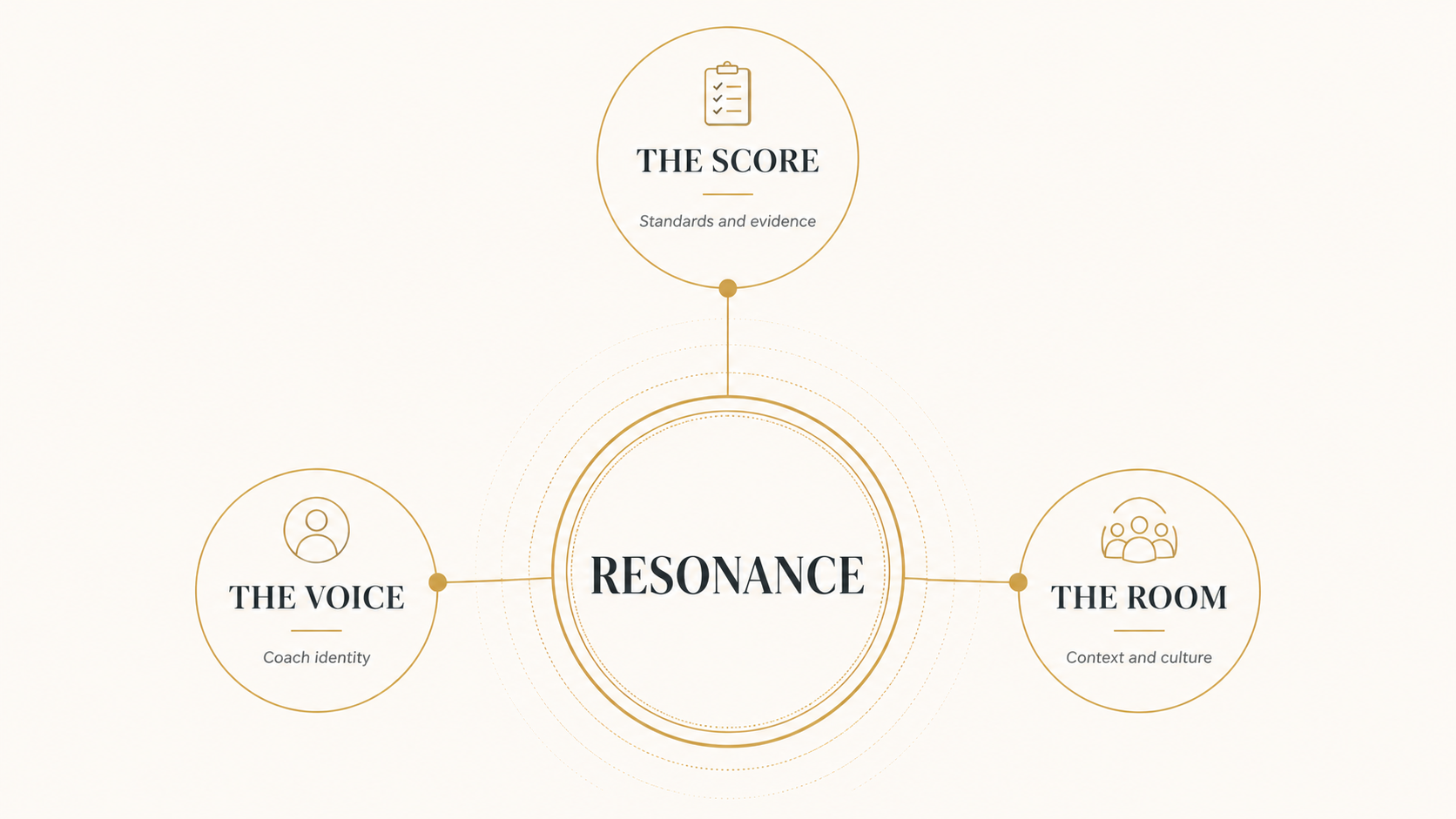
The Resonance Model
Standards, Voice and Context — Held Together.
The Score — the professional competencies and credential-level standard.
The Voice — the coach's individual presence, style, and developing artistry.
The Room — the culture, language, relationship, power, and context surrounding the feedback.
Using sympathetic resonance as a guiding metaphor, the mentor coach sounds the standard clearly without asking the coach to become an echo of the mentor.
Resonance, never echo.
What You Will Learn
Eight Core Learning Modules
-
Role, Ethics and Professional Distinctions
Purpose
Establish the professional identity, ethical responsibilities and boundaries of mentor coaching before learning the methods of the craft.Key Learning Highlights
Understand what mentor coaching is and what it is not.
Distinguish mentor coaching from coaching, supervision, assessment, education, consulting and therapy.
Work ethically with confidentiality, recording consent, data stewardship and professional claims.
Applied Learning
Work through realistic ethical and role-boundary scenarios and establish your baseline mentor coaching development profile. -
The Architecture of Co-Creative Mentor Coaching
Purpose
Learn a coherent architecture for developing coaching capability while protecting the coach's individuality.Key Learning Highlights
Work with the Score, Voice and Room.
Understand the five movements of a mentor coaching conversation.
Recognise common distortions such as cloning style, withholding calibration and overwhelming the coach.
Applied Learning
Experience a live mentor coaching demonstration and begin practising the model with peers from the early stages of the program. -
Hearing Coaching Across Credential Levels
Purpose
Develop the ability to hear how coaching capability changes across ACC, PCC and MCC.Key Learning Highlights
Deepen fluency in the ICF Core Competencies.
Recognise differences between evidence of a behaviour and the quality of its demonstration.
Understand how different coaching models and styles can still express the same professional standard.
Applied Learning
Listen to complete coaching conversations, capture behavioural evidence and develop whole-session interpretations. -
Evidence, Evaluation Tools and Professional Judgement
Purpose
Build reliable judgement by learning to evaluate coaching from evidence rather than impression or preference.Key Learning Highlights
Work with ACC BARS, PCC Markers and MCC BARS.
Distinguish observable evidence from inference.
Identify personal rating tendencies such as severity, leniency, halo bias and stylistic preference.
Applied Learning
Rate benchmark coaching recordings, compare interpretations and refine your judgement through facilitated calibration dialogue. -
Turning Evaluation Into Growth
Purpose
Learn to offer feedback that strengthens coaching capability, confidence and self-directed development.Key Learning Highlights
Begin with the coach's self-assessment.
Name strengths with precise behavioural evidence.
Select one or two meaningful development edges rather than overwhelming the coach.
Applied Learning
Practise spoken and written feedback, feedforward and between-session development experiments. -
Culture, Language, Generation and Power
Purpose
Develop the sensitivity to communicate the same professional standard appropriately across different relational and cultural contexts.Key Learning Highlights
Recognise how culture, hierarchy, language and identity shape feedback.
Adapt the feedback register without diluting the truth.
Work with face, safety, defensiveness and relational repair.
Applied Learning
Explore cross-cultural scenarios and redesign the same feedback for different people, relationships and contexts. -
Creating Development Across the Whole Group
Purpose
Learn to facilitate group mentor coaching where every participant learns, not only the coach whose work is being reviewed.Key Learning Highlights
Establish effective group agreements and learning roles.
Facilitate evidence-based peer contribution and collective calibration.
Manage airtime, hierarchy, competing interpretations and group dynamics.
Applied Learning
Design and facilitate structured group mentor coaching using live practice and faculty feedback. -
Reflective Practice and Professional Maturity
Purpose
Integrate your learning into a clear, ethical and distinctive identity as a mentor coach.Key Learning Highlights
Examine your assumptions, biases and recurring mentor coaching patterns.
Articulate your personal mentor coaching philosophy.
Build an ongoing development ecosystem involving peers, mentoring-on-mentoring and supervision.
Applied Learning
Complete your Personal Resonance Statement and create a post-program professional development plan.
Five Observed Mentor Coaching Sessions
Conduct mentor coaching using real coaching material and receive structured written faculty feedback after every observed session.
Mentoring-on-Mentoring
Review your own mentor coaching practice through individual and small-group developmental conversations. Examine your calibration patterns, feedback habits and recurring development edges.
Guided Independent Learning
Complete recording reviews, evidence capture, calibration exercises, written feedback, reflective journaling and preparation between live sessions.
Capstone and Professional Readiness Review
Integrate your learning through a reflective portfolio, a recorded mentor coaching analysis, your Personal Resonance Statement and a faculty oral review.
The practicum is described in the Instructor Guide as a progressive spine across the program: early observations emphasise agreements and evidence, later observations deepen feedback, cultural attunement and group mentor coaching.

Why Learn With Us
An original architecture. Not another checklist.

A Coherent
Learning Architecture
Connect standards, identity and context
Learn the Resonance Model as an integrated architecture for listening, calibration, developmental feedback and reflective practice. The Score, Voice and Room are treated as interconnected dimensions of mentor coaching.
Calibration Across
Credential Levels
Develop judgement beyond personal preference
Build the ability to hear and interpret coaching across ACC, PCC and MCC through evidence capture, benchmark recordings and facilitated calibration dialogue.
Culture and Context
as Core Practice
Read the Room without diluting the standard
Learn to adapt feedback across cultures, languages, generations, hierarchy and power while preserving professional accuracy, dignity and developmental value.
Repeated Observed
Development
Practise, receive feedback and try again
Complete five observed mentor coaching sessions, receive structured written feedback after each one, and carry a focused development edge into the next practice cycle.
Who the Program Is For
Designed for Experienced Coaches Ready to Develop Other Coaches
Resonance is designed for coaches who are ready to move beyond receiving mentor coaching and begin developing the capability to mentor, calibrate and support other coaches professionally.
Credentialed Coaches
Building or expanding a professional mentor coaching practice.
Coach Educators and Faculty
Supporting learners, reviewing coaching demonstrations and strengthening faculty calibration.
Internal Coaching Leads
Developing coaches and building professional coaching capability within organisations or communities.
Experienced Mentor Coaches
Seeking to examine, calibrate and renew their existing mentor coaching practice.
Admission and Readiness
-
Applicants should normally hold a current ICF credential: ACC with at least one renewal, PCC or MCC
-
Applicants with equivalent coaching education and substantial professional coaching experience may also be considered.
-
Admission includes a short Program Fit Consultation to explore your experience, goals, readiness and preferred language cohort.
-
This is an advanced professional program and is not intended as foundational coach education or as a substitute for the mentor coaching hours required for your own credential.