

Confluence · AACS
Become the supervisor coaches trust with their hardest sessions.
Confluence is the 80-hour advanced pathway in coaching supervision — for experienced coaches ready to hold space for the people who hold space. Built on an original model. Designed to meet the standards of the ICF Advanced Accreditation in Coaching Supervision. Next cohort: [DATE].
The problem
Who holds space for the people who hold space?
It's the session you replayed on the drive home. The client who reminded you of your own grief. The ethical grey area you weren't sure you handled well.
Coaches carry all of it, usually alone. Confluence is where someone finally holds space for the coach — and where you learn to become that someone.

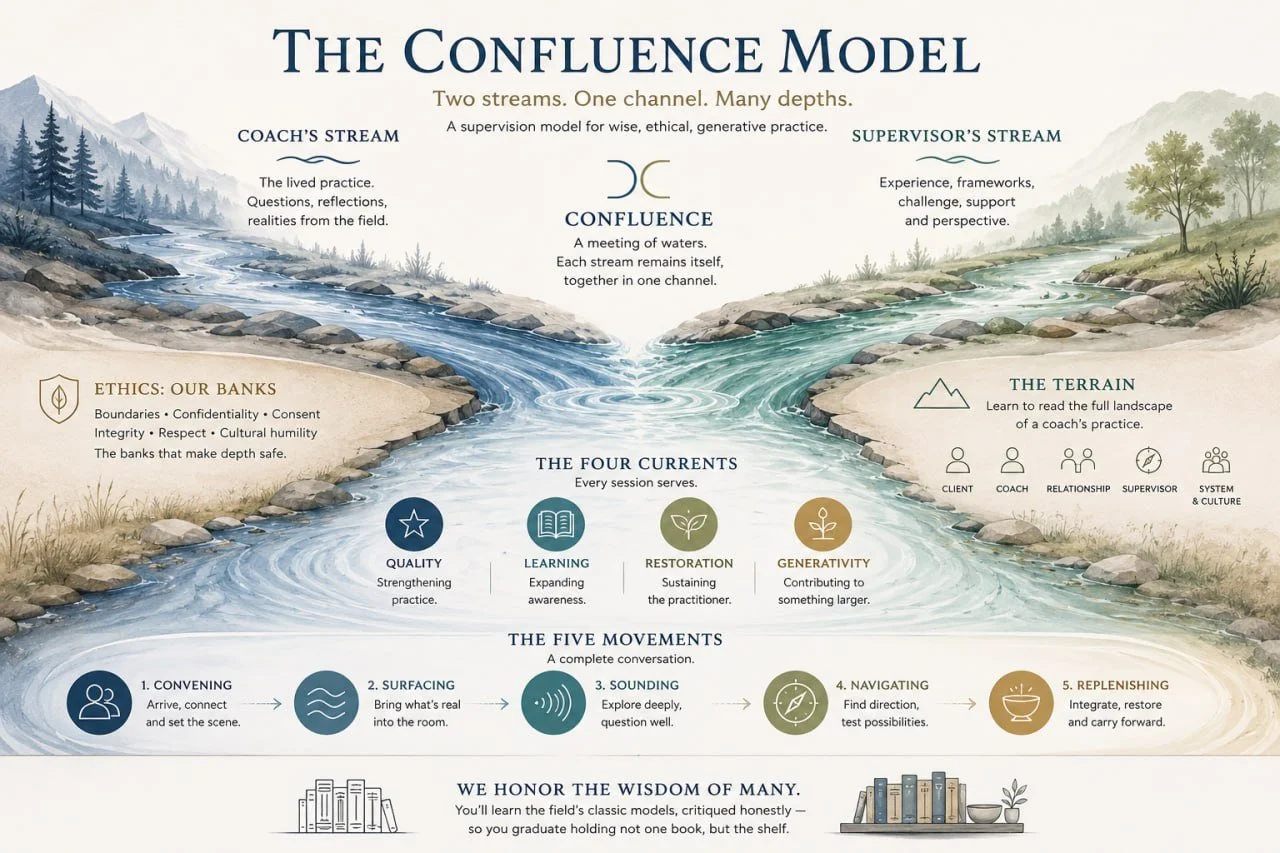
The Confluence Model
Confluence pictures supervision as a meeting of waters: the coach's stream and the supervisor's stream flowing in one channel, each still itself.
You'll learn to read the full Terrain of a coach's practice — client, coach, relationship, supervisor, system and culture, with ethics as the banks that make depth safe. You'll balance the four Currents every session serves — quality, learning, restoration and generativity. And you'll run a complete conversation through the Five Movements: Convening, Surfacing, Sounding, Navigating, Replenishing.
You'll also learn the field's classic models, critiqued honestly — so you graduate holding not one book, but the shelf.
Full curriculum
Eight modules. One river.
-
What it develops
A clear definition of supervision and how it differs from coaching, mentoring, therapy and assessment; the Confluence Model and the four Currents every session serves.
How you'll practice it
Watch a live faculty supervision demo; begin the reflective journal that runs the whole program.
-
What it develops
How to build the safe container before you work inside it: contracts for individual, group and organisational settings; confidentiality limits; the therapy boundary; records, tech and AI.
How you'll practice it
Draft three real contracts; write an ethics case analysis; an observed contracting round.
-
What it develops
The field's major models — Seven-Eyed, Proctor, Bernard, Holloway, developmental — critiqued for their assumptions and placed on the Confluence meta-map.
How you'll practice it
Write a comparative model critique paper; run a Stream Audit on a real case from your own practice.
-
What it develops
Your inner instrument: presence, somatic and emotional data, silence as intervention, parallel process, and protecting yourself from burnout.
How you'll practice it
Keep a Sounding Log across four sessions; build your personal sustainability and supervision plan.
-
What it develops
The module that most sets this program apart: working with face, hierarchy, harmony and power as live supervision material, with calibrated challenge that preserves dignity.
How you'll practice it
Complete a culture-and-power case analysis; work two dilemmas on the Ethical Tension Grid.
-
What it develops
Conducting complete individual supervision sessions through the Five Movements with real casework — the practicum spine.
How you'll practice it
Supervise in structured triads; 3 faculty-observed sessions with written feedback; a midpoint review.
-
What it develops
Contracting and facilitating supervision groups, the reflecting-team resonance round, and managing voice, silence, dissent and collusion.
How you'll practice it
Facilitate live group rounds; observed sessions 4 & 5 with written feedback; a group facilitation plan.
-
What it develops
Your own articulated model of supervision and a credible, ethical practice — with pathways to the ICF Coach Supervisor Specialization and EMCC ESIA.
How you'll practice it
Assemble the capstone portfolio; write your personal model paper; design your supervision practice plan.
Your own supervision, included
2 hours as a supervision client + 3 hours of supervision-on-supervision.
Assessed by demonstration
Five formal observed sessions, each with structured written feedback against published behavioral anchors, plus a four-part capstone with an oral review.
You leave with
The Brave Confluence Coach Supervisor (BCCS) designation, the full Confluence Supervision Toolkit, the program workbook, and assessed evidence toward the ICF Coach Supervisor route and EMCC ESIA.

Why learn this with us
Why learn this with Brave Your Story.
01
An original, published model
Confluence (supervision), Resonance (mentor coaching) and LEAD (coaching) are research-informed architectures you can use for a career — not a generic ICF checklist.
02
Taught by an MCC and ICF assessor
Jedi assesses PCC and MCC candidates for the ICF. You learn the standard from someone who applies it, and who builds coaches from Level 1 to mastery.
03
More than the minimum
Practice deliberately, with written feedback on every observed session. Readiness you can demonstrate, not just describe.
04
Cross-cultural by design
Working across cultures, languages and generations is core curriculum here — not a footnote.
05
A community, not a course
One philosophy — we become better coaches for one another — and an active alumni community of practice.
06
And, distinctively:
This is the only program built around the Confluence model of co-creative supervision, created and taught by its author.
Who it's for
Is this you?
Experienced coaches (PCC, MCC or equivalent) with an active practice.
Coaching program leaders and internal coaching leads.
Mentor coaches adding the reflective dimension.
Supervision-rich professionals who now coach.
Entry
At least 60 hours of coach-specific education and 500+ coaching hours; an active PCC or MCC is strongly recommended (and required to pursue the ICF Coach Supervisor Specialization).

Lead faculty
Jedidiah Alex Koh, MCC, ACTC
Master Certified Coach, coach educator and ICF assessor for PCC and MCC candidates. Founder of Brave Your Story, Singapore, and creator of the LEAD coaching model, the Confluence model of supervision, and the Resonance model of mentor coaching.
He has trained and mentored coaches from ACC to MCC across Asia and beyond, helps lead the ICF DEIB practitioners community, and is the author of Coaching Is Conversational Mastery and the LEAD series. His conviction runs through every program: coaching is conversational mastery, and we become better coaches for one another.

Partners
One program, three languages.
Owned and certified by Brave Your Story, and delivered with KTA 智用國際有限公司 (Chinese-speaking markets), Ikigai Kokoro Pte Ltd (Japanese-speaking markets) and DC Academy. One curriculum, one faculty standard, one certificate — across three languages and many time zones.

KTA 智用國際
Ikigai Kokoro
DC Academy
FAQ
Questions, answered.
-
No — it's advanced coach-specific education, designed to meet the standards of the ICF Advanced Accreditation in Coaching Supervision. It supplies assessed evidence toward supervisor pathways.
-
PCC, MCC or equivalent standing with an active practice. If you're close, book a call and we'll talk it through.
-
56% is synchronous, in two-hour online blocks set to respect a working coach's calendar. The rest is self-paced study built on the program's book and reflective journal.
-
Conduct individual and group supervision through the Five Movements, with your own articulated model, contracts and tools — demonstrated across five observed sessions and a capstone.
-
Yes — the same curriculum and certificate, delivered with our partners KTA and Ikigai Kokoro.

Dates & Investment
80 hours of preparation for thoughtful, ethical supervision.
Confluence™ is intentionally offered in small cohorts to support practice, observation and individual development.
Upcoming cohort
Our next programme dates are available on request.
Programme investment
Tuition varies according to pathway and enrolment arrangements. Contact us for the current programme fee, available payment options and upcoming schedule.
“Tell us a little about where you are in your supervision journey and we'll help you identify the most suitable starting point.”

Speak with our team today
Book a complimentary 30-minute call with a program consultant. We'll map your goal credential, your timeline and the right starting point — no pressure to enrol.